
Breast Options in a Mommy Makeover: Lift, Implants, or Both?
Key Takeaway
The breast component of a mommy makeover is not one-size-fits-all. Your options include mastopexy (lift) for sagging, implants for volume loss, a combination for both, or reduction for excess size. The right choice depends on your degree of ptosis, desired volume, and willingness to accept trade-offs like implant maintenance or additional scars. Each option adds 1–2 hours to your mommy makeover and has distinct recovery characteristics.
How Pregnancy and Breastfeeding Change the Breast
Understanding what has changed helps clarify which procedure addresses your concern. Pregnancy and lactation typically produce one or more of these changes:
- Volume loss (deflation): Breast tissue swells during pregnancy and lactation, then involutes. Many women end up with less volume than before pregnancy, particularly in the upper pole.
- Ptosis (sagging): Skin stretches during engorgement but may not retract. The nipple-areola complex drops below the inframammary fold. Classified in grades: Grade I (mild — nipple at fold level), Grade II (moderate — nipple below fold), Grade III (severe — nipple points downward), as classified in Annals of Plastic Surgery.1
- Asymmetry: Pre-existing asymmetry often becomes more pronounced after breastfeeding, particularly if one breast was used more than the other.
- Areolar enlargement: The areola may stretch and remain larger than desired after lactation.
- Tissue quality change: Glandular tissue may be replaced by fatty tissue, changing breast firmness and shape.
Your specific combination of these changes determines which surgical approach is most appropriate. For more on the relationship between breastfeeding and breast changes, see our breasts after breastfeeding guide.
Breast Lift (Mastopexy): Correcting Position
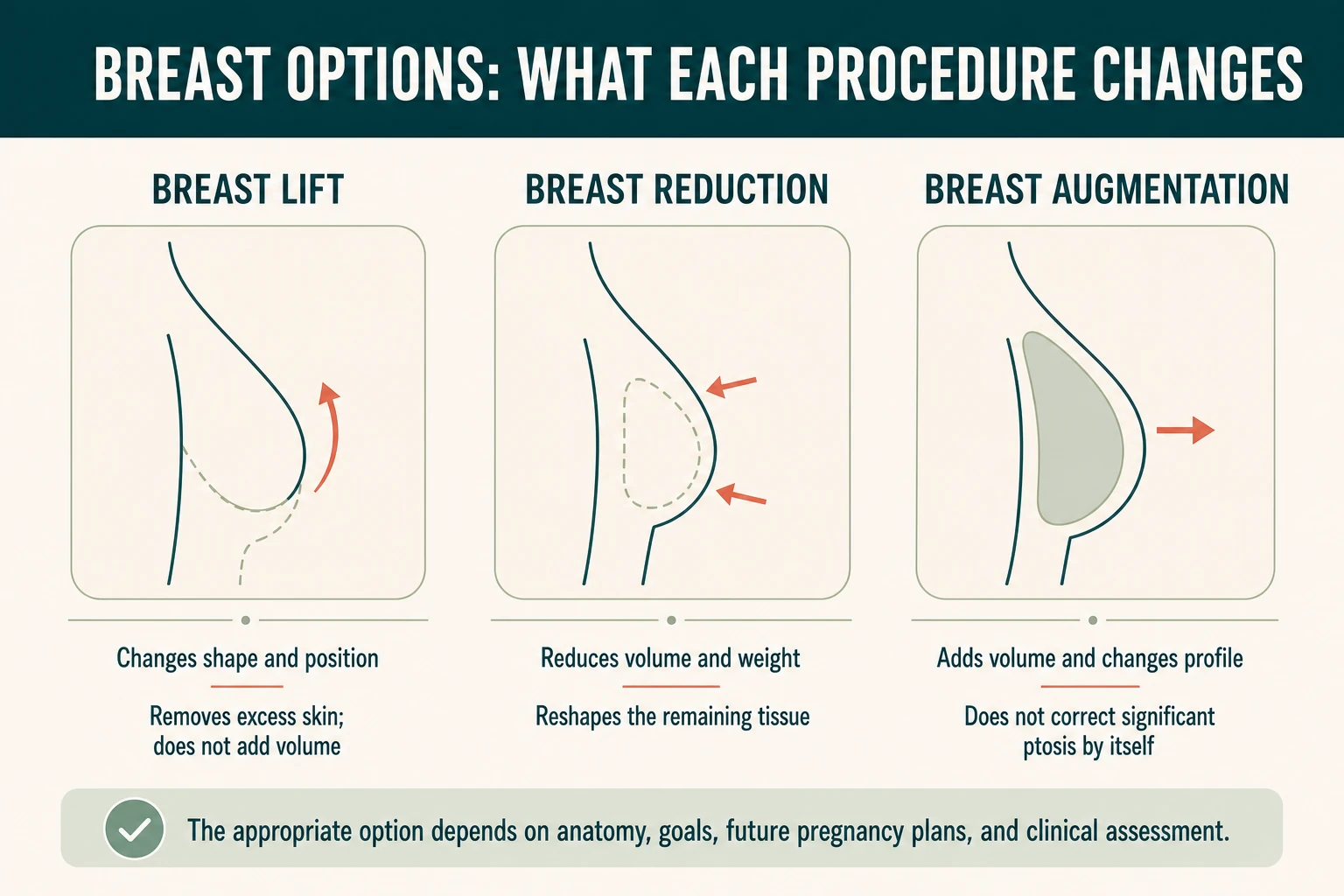
A mastopexy addresses ptosis by removing excess skin, reshaping breast tissue, and repositioning the nipple-areola complex higher on the chest wall. It does not add volume — it works with what you have.
Best For
- Women satisfied with their breast volume but unhappy with the position
- Grade II or III ptosis
- Those who want to avoid implants and their long-term maintenance
What to Expect
The lift creates a rounder, more youthful breast shape. It does not significantly change cup size — you will be approximately the same volume in a perkier position. Some patients feel their breasts look slightly smaller after a lift because the tissue is redistributed upward rather than hanging.
Scar Patterns
Scar extent depends on the degree of ptosis being corrected:
- Periareolar (donut): Around the areola only. For mild ptosis. Minimal scarring but limited lifting capacity.
- Vertical (lollipop): Around the areola plus a vertical line down to the fold. For moderate ptosis. The most common pattern in mommy makeover lifts.
- Inverted-T (anchor): Adds a horizontal incision along the fold. For severe ptosis with significant skin excess. Maximum lifting capacity.
Scars mature over 12–18 months, fading from pink/red to pale white in most patients. They are permanent but typically concealed within a bra or swimwear.
Added Operating Time
A breast lift adds approximately 1.5–2 hours to the mommy makeover when performed bilaterally.
Breast Implants: Restoring Volume
Implants address volume loss by adding a saline or silicone prosthesis behind the breast tissue or chest muscle. They restore fullness — particularly upper pole volume that deflates after breastfeeding.
Best For
- Women whose breast position is acceptable but who have lost significant volume
- Those with mild ptosis (Grade I) that can be corrected by the implant's internal support
- Patients wanting to increase cup size beyond their pre-pregnancy volume
Implant Choices
| Factor | Silicone Gel | Saline |
|---|---|---|
| Feel | More natural, softer | Firmer, may ripple |
| Rupture detection | Requires MRI (silent rupture) | Obvious deflation |
| Incision size | Larger (pre-filled) | Smaller (filled after placement) |
| FDA monitoring | MRI at 5–6 years, then every 2–3 years | No routine imaging required |
Placement can be submuscular (under the pectoralis) or subglandular (over the muscle). Submuscular provides more soft-tissue coverage and slightly lower capsular contracture rates according to long-term outcomes research, but recovery is more painful in the first week.2
Long-Term Considerations
Implants are not lifetime devices. The average implant lifespan is 10–20 years, after which replacement or removal may be needed. This is a long-term commitment, not a one-time procedure. Capsular contracture (hardening of scar tissue around the implant) occurs in approximately 8–15% of patients over 10 years.2
Added Operating Time
Breast augmentation adds approximately 45–90 minutes to the mommy makeover.
Augmentation-Mastopexy: Lift and Volume Together
When both ptosis and volume loss are present, combining a lift with implants addresses both problems simultaneously. This is technically the most demanding breast procedure in the mommy makeover context.
Why It Is More Complex
A lift removes skin to tighten. An implant adds volume that stretches skin. Balancing those goals requires significant surgical experience. In a retrospective series of 332 simultaneous augmentation-mastopexies, the overall complication rate was 22.9% and the reoperation rate was 23.2% (20.0% in primary and 30.9% in secondary cases).3 These single-practice results are more precise than a generic 10–20% estimate and may not predict another surgeon’s outcomes.
When to Consider This Option
- Grade II+ ptosis AND significant volume loss
- Desire for both upper pole fullness and elevated nipple position
- Understanding that revision probability is higher than with simpler approaches
The Two-Stage Alternative
Some surgeons prefer performing the lift first, allowing 3–6 months for tissue stabilisation, then adding implants in a second procedure. This staged approach reduces the technical complexity and may lower revision rates, but requires two recoveries.
Discuss with your surgeon whether a single-stage or two-stage approach is more appropriate for your degree of ptosis and desired implant size.
Added Operating Time
Augmentation-mastopexy adds approximately 2–2.5 hours to the mommy makeover.
Breast Reduction Within a Mommy Makeover
Not every post-pregnancy breast complaint is about sagging or deflation. Some women develop persistent macromastia — their breasts remain excessively large after pregnancy, causing back pain, shoulder grooving from bra straps, skin irritation in the inframammary fold, and difficulty with exercise.
What Reduction Involves
Breast reduction removes excess glandular tissue, fat, and skin to create a smaller, lighter, more proportional breast. It simultaneously lifts the breast (the lift is inherent in the technique). Scars are typically the inverted-T (anchor) pattern.
Combining Reduction With Abdominoplasty
Reduction mammaplasty can be combined with tummy tuck to address heavy, symptomatic breasts and abdominal laxity in one session. In a 2024 single-center retrospective cohort, combined breast reduction and abdominoplasty had a mean operating-room time of 226 minutes, compared with 115 minutes for breast reduction alone.4 Actual duration varies with the procedures, patient, surgical team, and facility.
Insurance Considerations
Unlike other mommy makeover components, breast reduction may be partially covered by insurance when medically indicated (chronic pain, skin infections, documented physical symptoms). If combined with cosmetic procedures, the breast reduction portion may still qualify — discuss this with your surgeon's billing team before the procedure.
How to Decide: A Framework
Use these three questions to guide your thinking before the consultation:
- What has changed most?
- Position dropped → lean toward lift
- Volume lost → lean toward implants
- Both → consider augmentation-mastopexy
- Too large → consider reduction
- What trade-offs am I comfortable with?
- Implants = long-term maintenance commitment
- Lift = scars but no foreign body
- Combined = higher revision probability
- Reduction = smaller size permanently
- What is my priority?
- Natural feel → lift without implants
- Upper pole fullness → implants or fat transfer
- Proportional reduction → reduction mammaplasty
- Maximum shape improvement → augmentation-mastopexy
Your surgeon's physical examination will confirm which options are anatomically appropriate. Not every option suits every patient — for example, a patient with very thin breast tissue may not be a good candidate for large implants, regardless of preference.
What to Expect: Recovery of the Breast Component
Within a mommy makeover, the breast and abdominal components recover simultaneously. However, the breast-specific recovery milestones include:
- Week 1–2: Swelling peaks. Surgical bra worn 24/7. Breasts sit high (especially with implants) — this is normal and they will settle.
- Week 3–6: Swelling resolves significantly. Implants begin to "drop and fluff" — descending into a more natural position. Lift patients see the shape refine as swelling decreases.
- Month 3: Approximately 80% of final result is visible. Scars are still pink/red.
- Month 6–12: Final shape and softness achieved. Scars fade. Sensory changes (numbness or hypersensitivity) largely resolve, though some permanent sensory change is possible according to nipple sensitivity research.5
The abdominal component typically dictates the overall recovery timeline. Most patients find that by the time their abdominal restrictions have lifted (6–8 weeks), their breast recovery is already well advanced.
Frequently Asked Questions
It depends on the specific change. If your breasts have sagged but you are happy with the volume, a lift alone is appropriate. If you have lost volume but the position is acceptable, implants restore fullness. If both position and volume are concerns, a combination (augmentation-mastopexy) addresses both.
Yes. A mastopexy (lift) reshapes and repositions existing breast tissue without adding volume. It removes excess skin and raises the nipple-areola complex. Many post-breastfeeding patients achieve an excellent result with lift alone.
Combining lift and implants is technically more demanding and has slightly higher revision rates than either procedure performed independently. Published data shows revision rates of 10–20% for augmentation-mastopexy vs 5–8% for augmentation alone. Surgeon experience with this specific combination matters significantly.
Yes. Some women develop persistent macromastia (excessively large breasts) after pregnancy. Reduction removes excess tissue and skin, creating a smaller, lighter breast. It can be safely combined with abdominoplasty in the same session.
The decision depends on three factors: your current breast position (degree of ptosis), your desired volume relative to current volume, and your tolerance for trade-offs like implant maintenance or additional scars. A physical examination determines which options are appropriate for your anatomy.
Key Takeaways
- Breast lift corrects position without adding volume — ideal for ptosis with adequate size.
- Implants restore lost volume — best when position is acceptable but fullness has diminished.
- Augmentation-mastopexy combines both but carries higher revision rates (10–20%).
- Reduction is appropriate when breasts remain symptomatic after pregnancy and may be partially insurance-covered.
- Implants are not lifetime devices — expect replacement or removal in 10–20 years.
- The breast component adds 1–2.5 hours to the mommy makeover depending on complexity.
Sources
- Rinker B, Veneracion M, Walsh CP. Breast ptosis: causes and cure. Ann Plast Surg. 2010;64(5):579-84.
- Handel N, Cordray T, Gutierrez J, et al. A long-term study of outcomes, complications, and patient satisfaction with breast implants. Plast Reconstr Surg. 2006;117(3):757-67; discussion 768-72.
- Calobrace MB, Herdt DR, Cothron KJ. Simultaneous augmentation/mastopexy: a retrospective 5-year review of 332 consecutive cases. Plast Reconstr Surg. 2013;131(1):145-156.
- Pouramin P, Dow T, Williams J. Exploring Complication Rates: A Comparative Study of Breast Reduction and Combined Breast Reduction with Abdominoplasty. Aesthetic Plast Surg. 2024;48(22):4660-4666.
- Mofid MM, Klatsky SA, Singh NK, et al. Nipple-areola complex sensitivity after primary breast augmentation: a comparison of periareolar and inframammary incision approaches. Plast Reconstr Surg. 2006;117(6):1694-8.