
Your Postpartum Belly: A Realistic Timeline of What Changes
Key Takeaway
Your postpartum belly changes on its own timeline — not social media’s. The uterus takes about 6 weeks to return to size, but skin, muscle, and fat changes continue for 12 months or longer. Most of what you see in the early months is still healing in progress, not a permanent state.
What Happens to Your Belly After Delivery
The moment after delivery, your belly does not return to its pre-pregnancy shape. This surprises many women, but it is entirely predictable. Your uterus spent 9 months expanding to the size of a watermelon. Your abdominal skin stretched to accommodate that growth. Your muscles separated to make room. None of these changes reverse instantly.
In the first hours and days after delivery, you may still look several months pregnant. This is normal. Immediately after delivery, the uterus weighs about 1,000 grams and remains enlarged, according to the NCBI Bookshelf review of postpartum physiology.1
Understanding what is happening inside — and when — can help set realistic expectations and reduce the frustration that many women feel when their body does not “bounce back” on someone else’s timeline.
The First 6 Weeks: Uterine Involution
The uterus begins contracting immediately after delivery. This process, called involution, reduces the uterus from its fully pregnant size back to its pre-pregnancy size over approximately 6 weeks. During this time:
- Week 1: The uterus is roughly at the level of the navel. You may feel cramping (afterpains), especially during breastfeeding, as oxytocin triggers uterine contractions
- Week 2–3: The uterus descends into the pelvis and becomes non-palpable through the abdominal wall
- Around week 6: uterine involution is usually near completion, with uterine weight returning to roughly 50–100 grams, as described in clinical physiology guidance.1
During these 6 weeks, significant fluid shifts also occur. Pregnancy increases blood volume by 40–50%, and the body gradually sheds this extra fluid through urine and perspiration. This fluid loss alone can account for noticeable changes in abdominal appearance.
However, even after involution is complete at 6 weeks, the belly will not look like it did before pregnancy. The skin, muscles, and fat have not yet had time to adapt.
Months 2–6: The Gradual Shift
This is the period where many women feel the most impatient — and the most bombarded by unrealistic expectations. Here is what is actually happening:
Skin Recovery
Stretched abdominal skin begins to retract, but the rate depends heavily on genetics, age, the degree of stretching, and whether stretch marks (striae gravidarum) developed. Collagen remodeling is a slow process. You may notice gradual tightening, but significant laxity can persist well beyond 6 months, as noted in a review of stretch mark management.2
Muscle Recovery
If you had diastasis recti during pregnancy (which affects an estimated 33–60% of women), some degree of spontaneous recovery occurs in the first 8 weeks.3 After that point, targeted core rehabilitation becomes the primary mechanism for further improvement. The muscles do not always close fully on their own.
Fat Redistribution
The body gradually returns to its pre-pregnancy fat distribution pattern, but this takes time — particularly if you are breastfeeding, as lactation requires maintained fat stores and hormonal environments that may keep some lower-abdominal fat in place.
Months 6–12+: What Stays and What Doesn’t
By 6–12 months postpartum, most of the hormonal and fluid changes have stabilized. What you see at this point is closer to (but not necessarily) the final result. Key factors that influence the appearance at this stage:
- Skin elasticity: determined largely by genetics and age. Women who had significant stretching may have permanent skin laxity that will not improve further without intervention
- Diastasis recti status: if the abdominal separation has not improved with rehabilitation by 12 months, it is unlikely to resolve spontaneously
- Body composition: overall weight and fat distribution. Gradual, healthy weight management supports the best outcome
- Number of pregnancies: each pregnancy adds cumulative change to the skin and muscles
Important: even at 12 months, you are not at the “final” state. Scar tissue (if you had a cesarean) continues to remodel for up to 2 years, and skin can continue to slowly tighten over 18–24 months.
What the “Mom Pooch” Usually Is
The term “mom pooch” describes a persistent lower abdominal fullness that many women notice after pregnancy. It can be caused by one or more of the following:
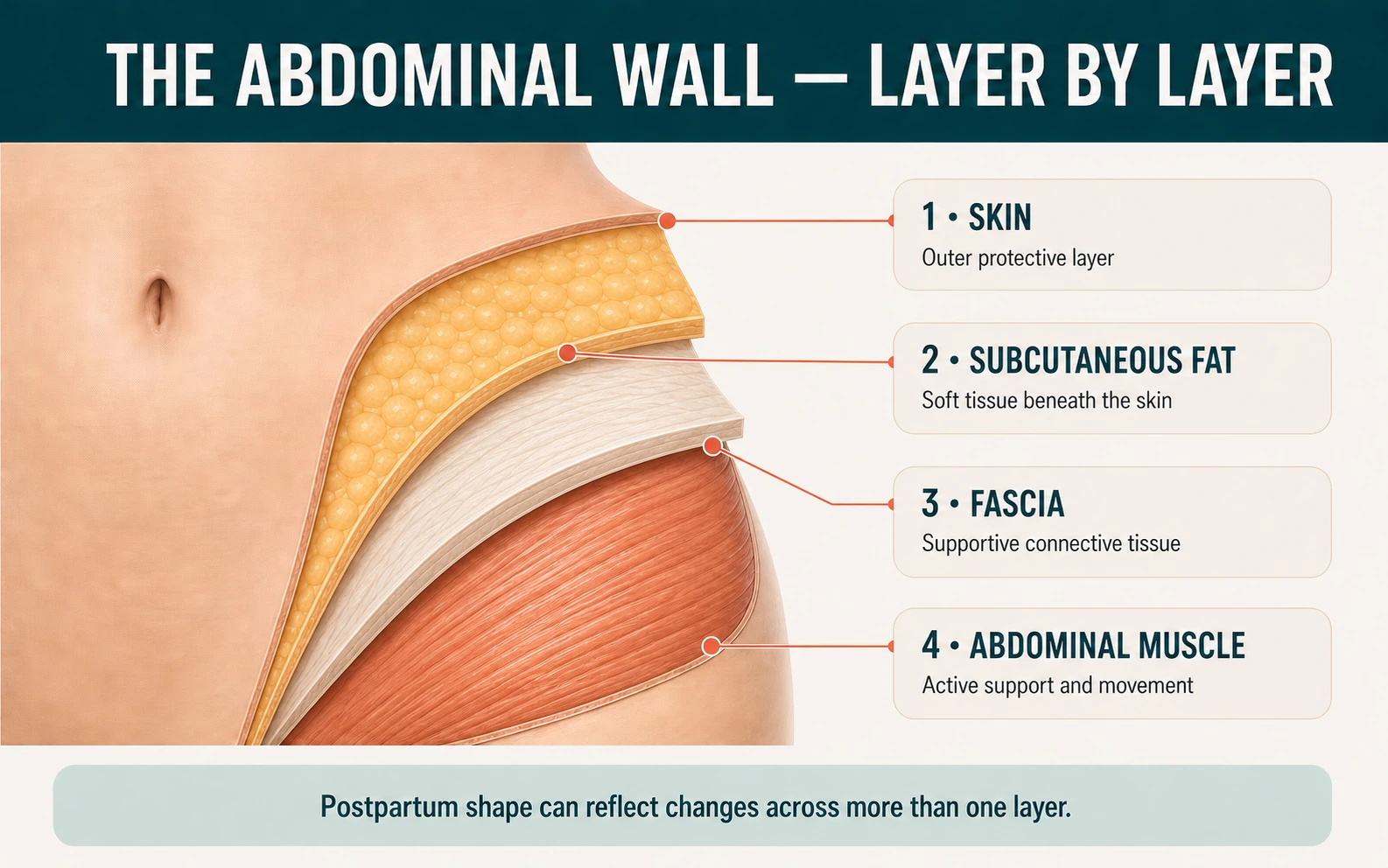
- Skin laxity: loose, soft skin that folds in the lower abdomen
- Subcutaneous fat: a small amount of lower-abdominal fat that is often hormonal and resistant to exercise
- Diastasis recti: weakened or separated abdominal muscles that allow the contents of the abdomen to push forward
- Scar adhesion (after cesarean): see our c-section shelf guide for more
The “mom pooch” is not a medical diagnosis — it is a description that can mean different things in different women. Understanding which factors are contributing in your case is important because the effective approach differs. Learn more in our dedicated mom pooch guide.
What You Can Influence
Core Rehabilitation
Working with a pelvic floor physical therapist to rebuild deep core strength is the single most impactful thing most women can do. This is not about aesthetics — it is about restoring the functional support system of the trunk. Proper core rehabilitation improves posture, reduces back pain, and can meaningfully reduce the appearance of the lower belly bulge, as supported by research on exercise and diastasis recti.4
Nutrition and Weight Stability
A balanced, nutrient-dense diet supports tissue healing and provides energy for the demands of new motherhood. There is no diet that targets belly fat specifically — spot reduction does not work. Gradual, sustainable weight management is the evidence-based approach.
Movement and Activity
Returning to physical activity after medical clearance (typically 6 weeks for vaginal delivery, 8–12 weeks for cesarean) supports overall health and body composition. Walking is an excellent starting point. Avoid high-impact activity or heavy lifting until core and pelvic floor function have been assessed.
What Social Media Gets Wrong
The “bounce back” narrative is pervasive, misleading, and harmful. Here is what those images typically do not show:
- Genetics: some women have naturally higher skin elasticity, lower pregnancy weight gain, and faster hormonal normalization. This is not discipline or effort — it is biology
- Timing: photos posted at 6 weeks are almost always the exception, not the norm. And they are selected, not representative
- Angles, lighting, and compression garments: presentation matters enormously in photography
- No mention of help: personal trainers, childcare support, nutritionists, and sometimes surgical intervention are rarely disclosed
Comparing your 4-month postpartum body to a curated image is not a fair comparison. It is also not medical information.
Normal vs When to Get Checked
Most postpartum belly changes are expected and resolve on their own timeline. A smaller set of symptoms warrants medical evaluation — here is how to tell them apart.
| Usually normal | Get evaluated by your provider |
|---|---|
| Soft, protruding lower belly for 12+ months | Visible midline bulge that appears with coughing or straining (possible hernia) |
| Diastasis gap that narrows over 6–12 months | Diastasis gap wider than 2 finger-widths that has not narrowed by 12 weeks |
| Mild lower back tightness with core-strengthening days | Persistent lower back or hip pain that limits daily activity |
| Occasional light spotting after activity in the first weeks | Heavy vaginal bleeding that soaks a pad in an hour, or bleeding that returns after stopping |
| Gradual, non-linear body composition change over a year | No change at all after 6+ months of consistent healthy habits |
| Feeling emotionally sensitive about body changes | Urinary leaking, pelvic heaviness, or a “falling-out” sensation (possible pelvic organ prolapse) |
None of the “get evaluated” symptoms are urgent unless accompanied by fever, foul-smelling discharge, or severe pain — those warrant same-day contact with your provider or urgent care.
When Surgery Becomes a Reasonable Question
After adequate time (generally 12–18 months minimum), completion of family planning, and exploration of non-surgical approaches, some women choose to explore surgical options for their postpartum belly. This is a personal decision, and it is valid.
The most relevant procedures include abdominoplasty (which addresses skin laxity, fat, and abdominal-wall laxity), liposuction (which addresses fat only — not skin or muscles), and sometimes a combination of both.
The American Society of Plastic Surgeons emphasizes that candidates should be at a stable weight, not planning future pregnancies, and in good overall health.5
For more on non-surgical options that should be considered first, see our non-surgical postpartum options guide.
Key Facts
- The uterus returns to pre-pregnancy size in approximately 6 weeks (involution)
- Skin, muscle, and fat changes continue for 12–24 months postpartum
- Diastasis recti affects 33–60% of postpartum women and may need targeted rehabilitation
- Spot reduction (targeting belly fat with exercises) does not work
- The “bounce back” narrative does not reflect normal postpartum recovery
- Most surgeons recommend waiting 12–18 months and completing family planning before considering surgery
Frequently Asked Questions
How long does it take for a postpartum belly to go away?
The uterus returns to its pre-pregnancy size within about 6 weeks. The visible belly changes continue for much longer — most women see the most significant improvements between 6 and 12 months postpartum, though skin, muscle, and fat changes can continue evolving for up to 2 years. The timeline varies widely depending on genetics, number of pregnancies, and individual healing.
Why do I still look pregnant months after delivery?
Several factors contribute: the uterus takes about 6 weeks to shrink back, abdominal muscles and connective tissue need time to recover, skin laxity improves over months, fluid retention continues for weeks, and fat distribution shifts during pregnancy. If the change remains pronounced or causes symptoms, a qualified healthcare provider can assess the underlying cause.
What is the “mom pooch” and is it the same as a postpartum belly?
The “mom pooch” is a colloquial term for persistent lower-abdominal fullness after pregnancy. It overlaps with the broader postpartum-belly concept but usually refers to a longer-term change rather than the immediate post-delivery appearance. Skin laxity, retained fat, abdominal-wall changes, or a combination of these factors can contribute.
Can exercise flatten a postpartum belly?
Exercise can rebuild core strength and improve muscle tone, which may reduce the belly’s appearance, but it cannot tighten substantial loose skin. A pelvic-floor physical therapist or other qualified clinician can assess abdominal-wall function and recommend a safe progression rather than relying on generic abdominal exercises.
When should I see a doctor about my postpartum belly?
See a healthcare provider if you notice a persistent midline bulge when you strain or sit up, lower-back pain, pelvic-floor symptoms, a suspected hernia, or no improvement after several months despite healthy habits. A qualified clinician or pelvic-floor physical therapist can assess abdominal-wall function and create an appropriate plan.
Key Takeaways
- The postpartum belly changes on its own timeline: uterine involution takes 6 weeks, but skin, muscle, and fat changes continue for 12–24 months
- Early postpartum appearance is mostly swelling and uterine size — not a preview of your permanent body
- The “mom pooch” can be caused by skin laxity, subcutaneous fat, diastasis recti, or a combination
- Core rehabilitation with a pelvic floor physical therapist is the most impactful non-surgical approach
- Social media “bounce back” images are not representative of normal recovery
- Surgery is a valid option after 12–18 months, family completion, and adequate trial of non-surgical approaches
Sources
- Chauhan G, Tadi P. Physiology, Postpartum Changes. StatPearls. Updated 2026.
- Wollina U, Goldman A. Management of stretch marks (with a focus on striae rubrae). J Cutan Aesthet Surg. 2017;10(3):124-129.
- Sperstad JB, Tennfjord MK, Hilde G, et al. Diastasis recti abdominis during pregnancy and 12 months after childbirth: prevalence, risk factors and report of lumbopelvic pain. Br J Sports Med. 2016;50(17):1092-6.
- Benjamin DR, van de Water AT, Peiris CL. Effects of exercise on diastasis of the rectus abdominis muscle in the antenatal and postnatal periods: a systematic review. Physiotherapy. 2014;100(1):1-8.
- American Society of Plastic Surgeons. Tummy Tuck (Abdominoplasty). ASPS. 2024.