Warning Signs After a Mommy Makeover: When to Call Your Surgeon
Key Takeaway
Most mommy makeover recoveries are uneventful, but knowing the difference between normal post-operative symptoms and dangerous warning signs can save your life. The most critical emergencies are pulmonary embolism (blood clot in the lungs), severe bleeding, and sepsis. This page tells you exactly what to watch for, what to do, and when to call 911 instead of waiting for your surgeon to call back.
Call 911 Immediately if You Experience Any of These
Do not wait, do not drive yourself, and do not call the surgeon first:
- Chest pain with shortness of breath
- Coughing up blood
- Uncontrolled bleeding soaking through bandages
- Sudden severe one-sided leg swelling, pain, warmth, or redness
- Loss of consciousness, seizure, or high fever with confusion
- Rapid heart rate plus lightheadedness or fainting
Detailed guidance and non-emergency symptom categories follow below.
Call 911 Immediately For These Symptoms
The following symptoms require emergency medical care. Do not wait to contact your surgeon. Do not drive yourself. Call 911 or have someone take you to the nearest emergency room immediately.
- Sudden shortness of breath — difficulty breathing that comes on quickly, especially if you were previously breathing normally
- Chest pain — particularly pain that worsens when you take a deep breath or cough
- Coughing up blood — even a small amount
- Rapid or irregular heartbeat — heart racing or pounding without exertion
- Lightheadedness or fainting — feeling like you’re about to pass out, or actually losing consciousness
- Heavy, uncontrolled bleeding — blood soaking through dressings that does not stop with firm pressure
- Sudden severe pain — pain dramatically worse than baseline that is not controlled by prescribed medication
These symptoms may indicate a pulmonary embolism (blood clot that has traveled to the lungs), hemorrhage, or other life-threatening emergency. Minutes matter. According to Keyes et al., the most common cause of death after cosmetic surgery is venous thromboembolism — and early recognition is the key to survival.1
Blood Clot Warning Signs (DVT and PE)
Blood clots are the most dangerous complication after combined surgery. They can form in the deep veins of the legs (deep vein thrombosis, or DVT) and potentially travel to the lungs (pulmonary embolism, or PE). According to Caprini, the risk is highest in the first 2 weeks after surgery but remains elevated for up to 6 weeks.2
Signs of DVT (Leg Blood Clot)
- Swelling in one leg — noticeably more than the other (some bilateral swelling is normal after surgery, but asymmetric swelling is a red flag)
- Pain or tenderness in the calf or thigh that worsens when you walk or flex your foot upward
- Warmth in the affected leg
- Redness or discoloration of the skin on one leg
- A firm, cord-like feeling along a vein
Signs of PE (Lung Blood Clot) — CALL 911
- Sudden shortness of breath
- Sharp chest pain, especially with deep breathing
- Rapid heartbeat
- Coughing up blood or bloody mucus
- Lightheadedness, dizziness, or fainting
- Anxiety or a sense that “something is very wrong”
Action: If you suspect DVT (leg symptoms only), contact your surgeon immediately — same-hour, not next-day. If you have any PE symptoms (chest or breathing), call 911. Do not wait. For more information, see the ASPS patient safety guidance on blood clot warning signs.3
Signs of Infection
A surgical site infection can become apparent after you leave the hospital. The CDC lists worsening redness or pain, cloudy wound drainage, and fever as warning signs and advises contacting your healthcare provider immediately if they occur.4 Knowing the difference between normal healing and infection is critical:
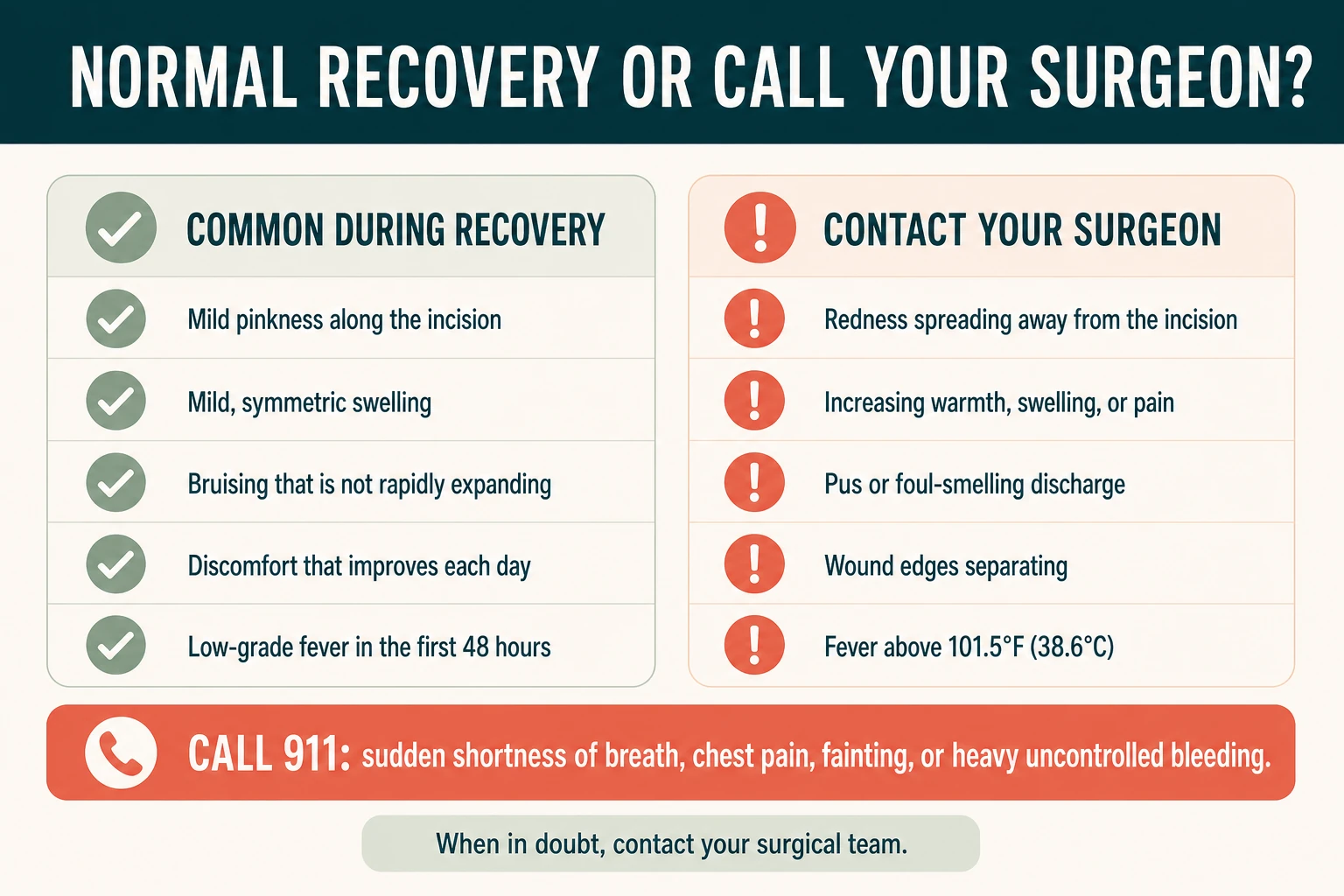
| Normal | Concerning |
|---|---|
| Mild pinkness along the incision line | Spreading redness extending outward from the incision |
| Mild warmth around the wound | Increasing warmth with redness and swelling |
| Small amount of clear or slightly blood-tinged drainage | Pus (thick, cloudy, yellow-green) or foul-smelling discharge |
| Mild discomfort that improves daily | Increasing pain at the wound after the first few days |
| Low-grade fever (<100.4°F) in first 48 hours | Fever >101.5°F (38.6°C) or any fever after 48 hours |
Additional warning signs of serious infection:
- Red streaks extending from the incision (may indicate lymphangitis — spreading infection)
- Chills or shaking
- Rapid heartbeat
- Confusion or disorientation
- Feeling significantly sicker than expected
Action: Contact your surgeon the same day. If you have high fever with chills, confusion, or feel severely ill, go to the ER.
Bleeding and Hematoma
Some oozing from incisions in the first 24–48 hours is normal. What is not normal:
- Active bleeding that soaks through dressings and does not stop with 15 minutes of firm, continuous pressure
- Rapid, asymmetric swelling — one side of the abdomen or one breast becoming noticeably larger than the other over hours (may indicate hematoma)
- Bruising that is expanding rapidly (not just stable bruising, which is normal)
- Feeling faint or dizzy with signs of bleeding — may indicate significant blood loss
Action: Apply firm pressure and contact your surgeon immediately. If bleeding is heavy and uncontrolled, or you feel faint, call 911 or go to the ER.
Wound Dehiscence (Opening)
Wound dehiscence — the incision opening partially or fully — can occur from tension on the wound, infection, or premature activity. Signs include:
- Edges of the incision separating (you can see into the wound)
- Sudden increase in drainage from the wound
- Pain at the wound site with visible gaping
Action: Do not attempt to close the wound yourself. Cover with a clean, moist gauze and contact your surgeon immediately. Small areas of dehiscence are managed with wound care. Larger openings may require surgical re-closure.
Breathing Problems
After abdominoplasty, particularly with muscle tightening, you may feel “tight” when breathing deeply for the first few days. This is normal and improves as swelling subsides and you gradually straighten your posture.
What is not normal:
- Sudden onset of shortness of breath (not gradual tightness)
- Inability to catch your breath
- Breathing that worsens rather than improves over days
- Blue or gray discoloration of lips or fingernails (cyanosis)
- Chest pain with breathing
Action: Sudden breathing difficulty — especially with chest pain — is a PE until proven otherwise. Call 911 immediately.
Fever
Understanding fever timing is critical:
- First 48 hours: Low-grade fever (up to 100.4°F / 38°C) is common and usually caused by the body’s inflammatory response, mild dehydration, or atelectasis (partial lung collapse from anesthesia). This is typically not concerning.
- After 48 hours: New fever or rising fever suggests infection and requires evaluation.
- Above 101.5°F (38.6°C) at any time: Contact your surgeon the same day.
- Above 103°F (39.4°C) with chills: Go to the ER.
Quick Reference: When to Act
| Symptom | Action |
|---|---|
| Sudden shortness of breath / chest pain | Call 911 immediately |
| Coughing up blood | Call 911 immediately |
| Fainting or loss of consciousness | Call 911 immediately |
| Heavy uncontrolled bleeding | Call 911 immediately |
| One-leg swelling, calf pain, warmth | Call surgeon immediately (same hour) |
| Fever >101.5°F / spreading redness / pus | Call surgeon same day |
| Wound edges separating | Call surgeon same day |
| Rapid asymmetric swelling | Call surgeon same day |
| Pain worsening after day 3–4 (should be improving) | Call surgeon next business day |
| Persistent nausea/vomiting preventing hydration | Call surgeon same day |
What IS Normal After Surgery
To help you distinguish warning signs from expected recovery symptoms:
- Normal: Bruising (may look alarming but is expected), moderate pain managed by prescribed medication, mild swelling that is roughly symmetric, numbness of the abdominal skin, constipation, fatigue, emotional ups and downs
- Normal but call if persistent: Nausea (should resolve in 24–48 hours), low-grade fever (first 48 hours only), mild drainage from incisions (clear or slightly blood-tinged)
For a detailed recovery timeline, see our week-by-week recovery guide. For general complication information, see risks and complications.
Preparation Saves Lives
Before your surgery, take these steps:
- Save your surgeon’s direct after-hours phone number in your phone — not just the office number
- Know the location of the nearest emergency room
- Make sure your support person reads this page and knows the warning signs too
- Keep a simple log of your temperature, pain level, and any symptoms for the first 2 weeks
- Do not hesitate to call — surgeons expect post-operative calls and would rather hear from you unnecessarily than miss a complication
Frequently Asked Questions
-
DVT signs: asymmetric leg swelling, calf pain worsening with walking or foot flexion, warmth, redness in one leg. PE signs (call 911): sudden shortness of breath, chest pain with breathing, rapid heartbeat, coughing up blood, lightheadedness or fainting.
-
Go to the ER for: sudden breathing difficulty, chest pain, coughing up blood, signs of blood clot in the leg, fever above 101.5°F with chills, heavy uncontrolled bleeding, loss of consciousness, or severe uncontrolled pain. Call 911 for breathing or chest symptoms.
-
Low-grade fever (up to 100.4°F) in the first 48 hours is common and usually not concerning. Fever above 101.5°F, or any fever after 48 hours, may indicate infection and requires evaluation by your surgeon.
-
Spreading redness around the incision, increasing warmth and swelling, pus or foul-smelling discharge, pain that increases after the first few days (should be decreasing), and fever. Red streaks from the incision suggest spreading infection. Contact your surgeon the same day.
-
Wound dehiscence (the incision edges separating) can result from tension, infection, or activity resumed too soon. Cover with clean, moist gauze and contact your surgeon immediately — do not try to close it yourself. Small areas are managed with wound care; larger openings may need surgical re-closure.
Key Takeaways
- Call 911 immediately for sudden breathing difficulty, chest pain, coughing up blood, or heavy uncontrolled bleeding.
- Blood clot symptoms in the leg (asymmetric swelling, calf pain, warmth) require same-hour contact with your surgeon.
- Fever above 101.5°F or developing after 48 hours post-surgery suggests infection — contact your surgeon the same day.
- Wound infection signs include spreading redness, pus, increasing pain, and foul-smelling discharge.
- Keep your surgeon’s after-hours number saved and make sure your support person knows these warning signs.
- When in doubt, call. Surgeons would rather hear from you unnecessarily than miss a complication.
Sources
- Keyes GR, Singer R, Iverson RE, et al. Mortality in outpatient surgery. Plast Reconstr Surg. 2008;122(1):245-250.
- Caprini JA. Thrombosis risk assessment as a guide to quality patient care. Dis Mon. 2005;51(2-3):70-8.
- American Society of Plastic Surgeons. Patient Safety. ASPS. 2024.
- Centers for Disease Control and Prevention. Surgical Site Infection Basics. Updated 2024.