Mommy Makeover Recovery Time: A Week-by-Week Timeline
Key Takeaway
Mommy makeover recovery time is best measured in weeks and months, not days. Week 1 is the hardest. Most women return to desk work in 2–3 weeks and light exercise by weeks 4–6. Full recovery with final results takes 3–6 months. The most critical restriction for mothers is lifting: nothing over 10 pounds for 6 weeks. Planning childcare in advance is not optional.
Why Combined Recovery Differs
A mommy makeover is not one operation — it is usually an abdominoplasty combined with a breast procedure (augmentation, lift, or both) performed in the same operative session. Because two separate surgical sites are healing simultaneously, mommy makeover recovery time behaves differently than recovery from either procedure on its own. Restrictions from the abdominal repair (no heavy lifting, bent-forward posture, drains) and restrictions from the breast procedure (no overhead reaching, supportive bra, careful sleeping position) layer on top of each other rather than happening one at a time.
This layering matters practically: combined procedures often take longer, and longer operative time is associated with higher morbidity in plastic-surgery cohorts.4 Recovery planning should therefore follow the actual combination performed and the surgeon’s instructions, not a timeline written for one standalone procedure.
Week 1: The Hardest Week
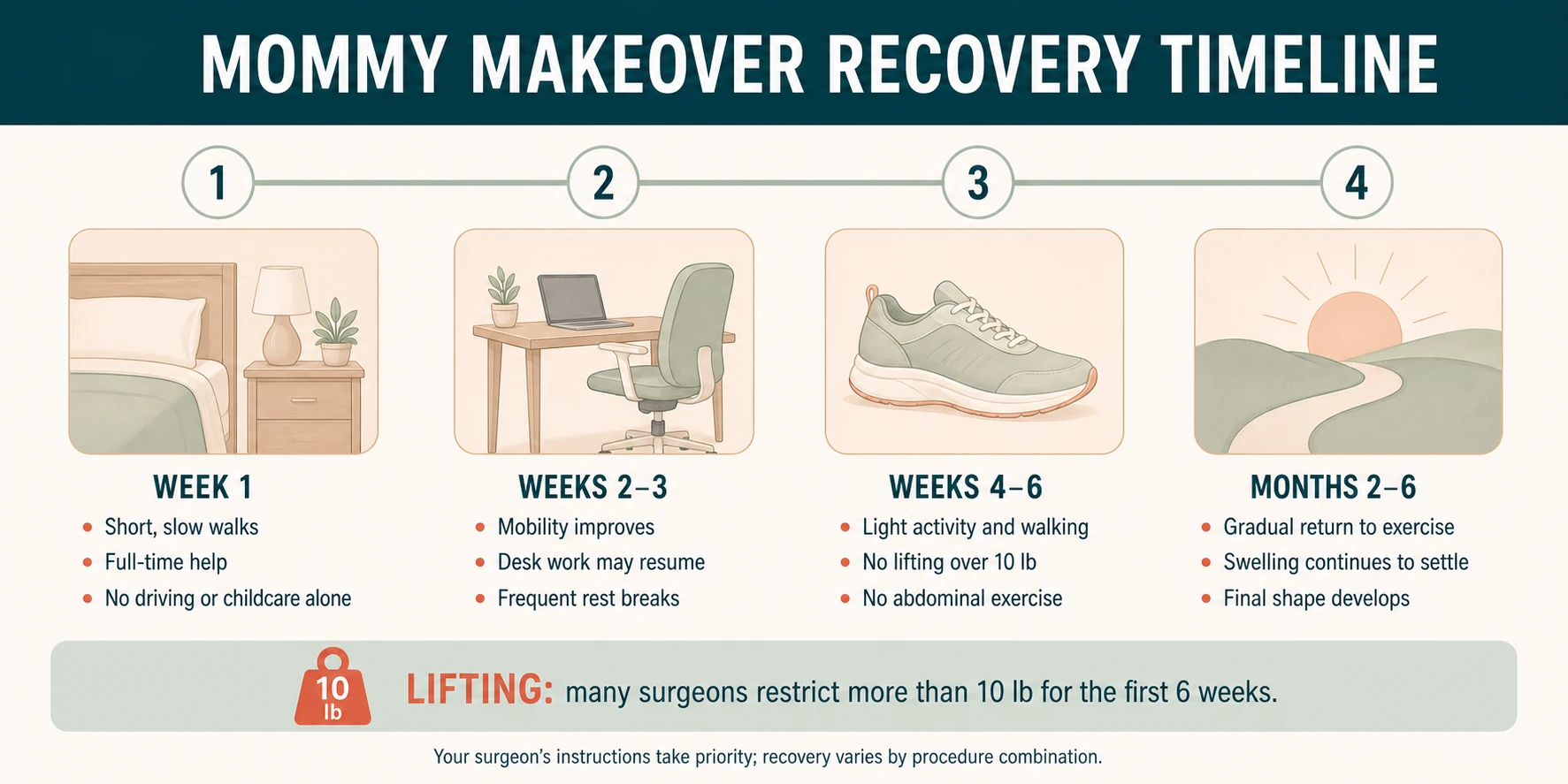
The first week is the most physically and emotionally demanding period of recovery. Here is what to expect:
- Pain: Moderate to significant, particularly in the abdomen. Muscle repair (diastasis recti correction) is the primary pain source. Prescribed pain medication is essential for the first 3–5 days. Breast pain is typically milder unless implants were placed.
- Mobility: You will walk bent forward at the waist after abdominoplasty. This protects the abdominal repair and reduces tension on the incision. Walking is important from day 1 — short, slow walks every few hours to prevent blood clots.
- Drains: Most surgeons place surgical drains during abdominoplasty. These are small tubes that collect fluid and typically remain in place for 5–14 days. You’ll need to empty and measure the output. Drains are mildly uncomfortable but not painful.
- Swelling and bruising: Significant and expected. Your abdomen will look much larger than your final result. This is normal. Swelling peaks around day 3–5 and gradually improves.
- Compression garments: Worn 24/7 (except for showering) starting immediately. They reduce swelling, support the repair, and improve comfort, as recommended by ASPS recovery guidelines.1
- Daily life: You cannot drive, lift anything over 5 pounds, cook, clean, or care for children independently. You need a dedicated caregiver for your own needs and — critically — full-time help with your children.
Weeks 2–3: Turning the Corner
- Pain: Transitioning from prescription pain medication to over-the-counter options (acetaminophen, ibuprofen). Discomfort shifts from sharp pain to tightness and soreness, especially when straightening up.
- Mobility: Gradually standing more upright. You can walk around the house more freely and take short walks outside. You’re still not driving (most surgeons clear driving at 2–3 weeks, when you can perform an emergency stop without pain).
- Drains: Usually removed by week 2 (when output drops below 30 mL/day). This is a significant milestone — most women feel much more mobile after drain removal.
- Swelling: Still substantial but visibly improving. You may notice “good days and bad days” where swelling fluctuates based on activity level. This is normal.
- Work: Some women with desk jobs return to remote work at the end of week 2 or during week 3, with frequent breaks. Physical work is not possible yet.
- Emotional state: Many women experience a dip in mood around week 2 — the initial excitement wears off, you’re still swollen and bruised, and you can’t see results yet. This is common and temporary.
Weeks 4–6: Visible Progress
- Pain: Mostly resolved. Occasional tightness, especially after prolonged sitting or standing. Numbness of the abdominal skin is still present (this is normal and gradually improves over months).
- Activity: Light activity and walking are encouraged. Most women are driving, handling light household tasks, and returning to work (desk jobs), consistent with ASPS mommy makeover guidelines.3 No lifting over 10 pounds, no exercise beyond walking, no abdominal exercises.
- Swelling: Major swelling has resolved. You can start to see your emerging shape. But residual swelling — particularly in the lower abdomen — persists. This is the beginning of “swell hell” for some women, where day-to-day fluctuations make it hard to gauge the final result.
- Scars: Incisions are healing but still red and raised. Scar management (silicone sheets or gel) can begin once incisions are fully closed, usually around week 4–6.
- Lifting restriction ends: Around week 6, most surgeons clear patients to begin gradually increasing lifting. This is when you can start picking up your children again — but gradually, not immediately back to carrying a toddler on your hip.
Months 2–6: Final Shape Emerges
- Exercise: Most surgeons clear return to exercise at 6–8 weeks, starting with low-impact activities and gradually adding intensity. Core exercises are typically the last to be cleared (8–12 weeks).
- Swelling: Residual swelling gradually resolves. The lower abdomen is the last area to fully deflate. According to prospective outcome data, most women see 80–90% of their final result by month 3, with subtle improvements continuing through month 6.2
- Breast shape: If implants were placed, they “drop and fluff” — settling from an initially high position into a more natural shape. This process takes 3–6 months.
- Scars: Transitioning from red/pink to lighter tones. Full scar maturation takes 12–18 months. Consistent use of silicone products and sun protection helps.
- Sensation: Numbness in the abdomen gradually improves as nerves regenerate. Some women experience tingling or hypersensitivity during this phase — this is a sign of nerve recovery and is normal.
- Final results: By month 6, most women are seeing their final shape, wearing normal clothing, and back to full activity. Scars continue to improve for another 6–12 months.
Lifting Restrictions With a Baby or Toddler
The 6-week lifting restriction is the single most impactful aspect of mommy makeover recovery time for mothers of young children. It means:
- You cannot pick up your baby, toddler, or young child
- You cannot carry groceries, laundry baskets, or heavy objects
- You cannot push a vacuum or mop vigorously
- You cannot lift a car seat with a child in it
Lifting too early risks disrupting the muscle repair, causing wound dehiscence, or developing a hernia. This is not a suggestion — it is a medical necessity. Read our detailed recovery with kids guide for practical planning strategies.
Returning to Exercise
Exercise clearance is one of the most-asked questions about mommy makeover recovery time, and it comes in phases rather than a single “all clear” date:
- Weeks 1–4: Short, slow walks only — important for circulation and blood clot prevention, not for fitness.
- Weeks 6–8: Most surgeons clear low-impact cardio (stationary bike, brisk walking, light elliptical) once the incision is fully closed and swelling has meaningfully improved.
- Weeks 8–12: Core-specific and abdominal exercises are typically the last cleared, since these directly load the muscle repair. Strength training with light weights usually resumes gradually in this window.
- 3 months and beyond: Full return to pre-surgery training intensity, including running and heavier resistance work, once your surgeon confirms the repair has fully matured.
Every surgeon's timeline differs slightly based on your specific combination of procedures. See our full guide to returning to exercise for a detailed, activity-by-activity breakdown.
Warning Signs During Recovery
Most mommy makeover recoveries are uneventful, but knowing which symptoms are normal and which require urgent attention is part of planning your recovery time. Contact your surgeon immediately for fever above 101.5°F (38.6°C), spreading redness or pus at an incision, asymmetric leg swelling or calf pain, or bleeding that will not stop with firm pressure. Sudden shortness of breath, chest pain, or coughing up blood is a medical emergency — call 911. See our full warning signs guide for the complete list of normal-vs-concerning symptoms by recovery stage.
Frequently Asked Questions
-
Most women need 2–3 weeks before returning to desk work. Full recovery takes 3–6 months. Lifting restrictions last 6 weeks. Final results emerge over 3–6 months.
-
Most surgeons restrict lifting over 10 pounds for 6 weeks. For toddlers or infants, this means no picking up, carrying, or car seat lifting for at least 6 weeks. Plan for full-time help.
-
Week 1 is universally the hardest. Pain peaks, mobility is limited, and you’re dependent on others. Most women report significant improvement by day 5–7.
-
General shape improvement by weeks 4–6. About 80–90% of final result by month 3. Final shape by month 6. Scars continue maturing for 12–18 months.
-
A mommy makeover combines abdominal and breast procedures in one session, so two surgical sites heal at once and restrictions from each stack together. Longer combined operative time is linked to higher complication rates, which is why surgeons plan a more conservative, layered recovery timeline than either procedure alone would need.
Key Takeaways
- Week 1 is the hardest — plan for full-time help and complete dependence on a caregiver.
- Most women return to desk work in 2–3 weeks.
- The 6-week lifting restriction is non-negotiable and critical for mothers of young children.
- Swelling fluctuates for months; final results emerge at 3–6 months.
- Scars continue improving for 12–18 months with proper care.
- Know the warning signs that require immediate medical attention during recovery.
Sources
- American Society of Plastic Surgeons. Tummy Tuck Recovery. ASPS Patient Education. 2024.
- Swanson E. Prospective outcome study of 360 patients treated with liposuction, lipoabdominoplasty, and abdominoplasty. Plast Reconstr Surg. 2012;129(4):965-978.
- American Society of Plastic Surgeons. Mommy Makeover: What You Should Know. ASPS. 2024.
- Hardy KL, Davis KE, Constantine RS, et al. The impact of operative time on complications after plastic surgery: a multivariate regression analysis of 1753 cases. Aesthet Surg J. 2014;34(4):614-22.