When Can You Exercise After a Mommy Makeover?
Key Takeaway
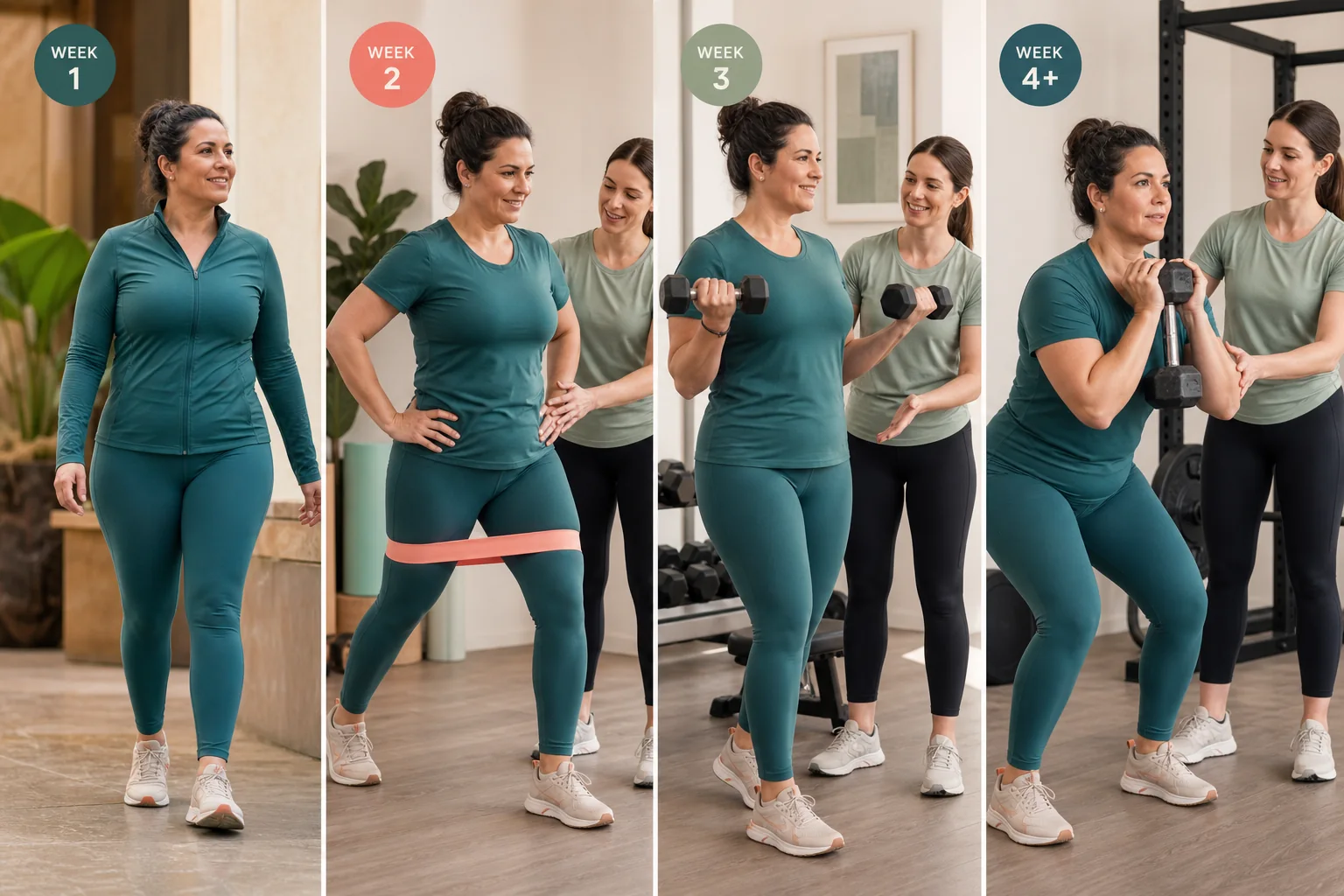
Walking starts on day 1 and is essential for blood clot prevention. Light activity resumes at weeks 3–4. Most surgeons clear low-impact exercise at weeks 6–8 and full exercise (including core work and high-impact activities) at weeks 8–12. The abdominal muscle repair is the rate-limiting factor — rushing core exercises risks undoing the surgical result. Always get explicit clearance from your surgeon before progressing.
Phase 1: Day 1 — Walking Starts Immediately
Walking is not just allowed after surgery — it is medically important. Short, slow walks starting the day of surgery are one of the most effective measures for preventing venous thromboembolism (blood clots), the leading cause of death after cosmetic surgery, according to Caprini’s thrombosis risk assessment.1
- Day of surgery / day 1: Walk to the bathroom and back, several times per day. You will walk slowly, hunched forward at the waist if you had abdominoplasty.
- Days 2–7: Gradually increase to short walks around the house every 1–2 hours while awake. Even 5 minutes at a time makes a difference.
- Weeks 1–2: Extend walks to 10–15 minutes, flat surfaces, slow pace. You’re gradually straightening your posture.
Walking is your only exercise for the first 3–4 weeks. It promotes circulation, supports healing, prevents constipation, and maintains your baseline fitness. It should never be painful — if it hurts, slow down or shorten the distance.
Phase 2: Weeks 3–4 — Light Activity
By week 3, most women feel significantly better and are tempted to do more. Resist the urge to jump back into your pre-surgical routine. Light activity means:
- Longer walks (20–30 minutes, flat terrain)
- Gentle stretching (upper body only — no abdominal stretches)
- Light household tasks (loading the dishwasher, folding laundry — nothing over 10 pounds)
- Driving (once cleared by your surgeon and you can perform an emergency stop without pain)
Still off-limits: Any exercise that raises your heart rate significantly, lifting weights, yoga (many poses engage the core), swimming (incisions must be fully healed before submerging), jogging or running, cycling, or any activity that causes visible abdominal swelling.
Phase 3: Weeks 6–8 — Return to Low-Impact Exercise
At approximately 6 weeks, most surgeons clear patients for a gradual return to exercise — with important restrictions, as outlined in ASPS tummy tuck recovery guidelines.2 This typically requires an in-office evaluation to confirm adequate healing.
Cleared activities (with surgeon approval):
- Brisk walking and light hiking
- Stationary cycling (recumbent preferred initially)
- Elliptical machine (low resistance)
- Light upper-body weight training (no exercises that engage the core under load)
- Swimming (only if incisions are fully healed — confirm with your surgeon)
- Yoga (modified — avoid deep twists, planks, and core-heavy poses)
Still off-limits: Crunches, sit-ups, planks, and any direct abdominal exercises. Heavy weight lifting. High-impact activities (running, jumping, HIIT). Activities with significant bouncing (trampoline, horseback riding).
Phase 4: Weeks 8–12 — Full Exercise Returns
Between weeks 8 and 12, most surgeons progressively clear patients for full exercise, including:
- Running and jogging (start with intervals, build gradually)
- HIIT and cardio classes
- Full weight training (including deadlifts, squats with load)
- Core exercises (start gently — see below)
- Contact sports and recreational activities
The exact timeline depends on your specific combination of procedures, whether muscle repair was performed, and how your body is healing. A patient who had a tummy tuck with muscle repair plus breast augmentation may need longer than someone who had a breast lift with liposuction only.
Timeline by Procedure Combination
Not every mommy makeover includes the same combination of procedures, and your exercise timeline shifts depending on what was actually done:
- Breast augmentation or lift only (no abdominal surgery): Because there is no muscle repair to protect, lower-body cardio such as walking and stationary cycling can often progress faster. The main restriction is upper-body and chest-engaging movement — push-ups, chest press, and overhead lifting — usually held until 6–8 weeks to protect implant position and incisions.
- Tummy tuck with muscle repair (rectus plication): This is the longest and most restrictive timeline. Any exercise that loads the abdominal wall — including some yoga poses, rowing machines, and even certain forms of intense coughing or laughing — needs to be approached cautiously until the 8–12 week mark.
- Liposuction of the flanks or thighs: Treated areas may be tender and swollen for several weeks, but liposuction alone does not involve muscle repair, so the exercise timeline is generally shorter than for a full tummy tuck — often 4–6 weeks for cardio, with heavier lower-body strength work following surgeon clearance.
- Full mommy makeover (tummy tuck + breast surgery, with or without liposuction): Follow the more conservative abdominal timeline throughout, since the muscle repair is the rate-limiting factor regardless of what else was done at the same time.
Staying Active Without Risking Your Results
Being restricted from your usual routine for 2–3 months does not mean doing nothing. Several strategies help you stay engaged with fitness while protecting your surgical result:
- Lower-body, non-core cardio: Once cleared for low-impact activity, a recumbent bike or elliptical with a stable, upright posture lets you maintain cardiovascular fitness without loading the abdominal repair.
- Breathing and posture work: Diaphragmatic breathing and gentle postural exercises can be started early (with surgeon approval) and lay the groundwork for safely re-engaging the core later.
- Protein and nutrition: Muscle repair and wound healing both require adequate protein intake. Talk to your surgeon or a dietitian about your needs during recovery rather than restricting calories.
- Mental framing: Athletes and previously very active women often struggle most with this phase. Reframing rest as an active part of the surgical result — not a pause from it — can help with the psychological adjustment.
- Sleep and stress management: Both support tissue repair and immune function, indirectly speeding a safe return to activity.
Returning to Core Exercises Safely
The abdominal muscle repair (rectus plication) is the rate-limiting factor for core exercise. Premature core work can disrupt the sutures, causing the muscles to separate again — the exact condition you had surgery to fix.
When cleared (typically 8–12 weeks), follow a graduated approach:
- Weeks 8–10: Gentle engagement — Draw the belly button toward the spine and hold for 10 seconds (transverse abdominis activation). Pelvic tilts lying on your back. No resistance.
- Weeks 10–12: Progressive loading — Modified planks (from knees, 10–15 seconds). Bird-dogs. Gentle Pilates-style exercises.
- After week 12: Traditional exercises — Full planks, crunches, bicycle kicks, leg raises. Start with low reps and build gradually. Stop immediately if you feel any pulling, popping, or sharp pain at the repair site.
Pelvic Floor Considerations
Many women undergoing a mommy makeover also have some degree of pelvic floor dysfunction from pregnancy and childbirth, as noted by the American College of Obstetricians and Gynecologists.3 This is often overlooked in the exercise discussion.
- Kegel exercises (pelvic floor contractions) are generally safe to begin within the first few days after surgery, as they don’t strain the abdominal repair. Check with your surgeon.
- Impact activities (running, jumping) can worsen pelvic floor weakness. If you experience urinary leakage during exercise after surgery, consider a pelvic floor physiotherapy assessment before increasing impact.
- Heavy lifting causes intra-abdominal pressure that stresses both the abdominal repair and the pelvic floor. Proper breathing technique (exhale on exertion) is essential when returning to weight training.
A pelvic floor physiotherapist can be a valuable resource — both before surgery (to establish baseline) and during recovery (to guide safe return to exercise).
What to Avoid and Why
| Activity | Why to Avoid | When Safe |
|---|---|---|
| Running / jogging | Impact and bouncing stress incisions and breast tissue | 8–12 weeks |
| Crunches / sit-ups | Direct stress on rectus muscle repair | 8–12 weeks (graduated) |
| Heavy weight lifting | Increases intra-abdominal pressure; risks hernia | 8–12 weeks |
| Swimming | Submersion risks wound infection before full closure | 6–8 weeks (if incisions healed) |
| Hot yoga / Bikram | Heat increases swelling and bleeding risk | 8–12 weeks |
| CrossFit / HIIT | Combines core, impact, and heavy lifting | 10–12 weeks |
How to Know If You’re Doing Too Much
Your body gives clear signals when you’re overexerting during recovery:
- Increased swelling after activity (compared to the morning) — the most common sign
- Pain at the surgical site that wasn’t present before the activity
- Increased bruising or new bruising appearing
- Drainage from incisions after they had stopped draining
- Fatigue disproportionate to the effort — your body is still healing internally
If any of these occur, reduce your activity level for 3–5 days and reassess. If symptoms persist, contact your surgeon. For emergency warning signs, seek immediate medical attention.
Frequently Asked Questions
-
Day 1. Short, slow walks starting the day of surgery are essential for blood clot prevention. Walk slightly bent at the waist and gradually increase distance over the first 2 weeks.
-
Most surgeons clear full exercise at 8–12 weeks. This includes cardio, strength training, and impact activities. Core exercises are typically the last to be cleared. Always get explicit clearance.
-
Not for at least 8–12 weeks. The muscle repair needs time to heal. Start with gentle core engagement before progressing to traditional exercises. Starting too early risks disrupting the repair.
-
Returning too early can cause complications that compromise results. Returning at the right time supports results by maintaining muscle tone and healthy weight. Patience during healing, consistency after clearance.
-
Gentle, modified yoga avoiding twists, planks, and core-heavy poses may be approved around weeks 6–8. Full yoga practice, including deep twists and inversions, typically waits until after the 8–12 week core clearance since many poses load the abdominal wall.
-
Desk jobs are usually fine within 1–2 weeks. Jobs requiring lifting, prolonged standing, or physical exertion typically need 6–8 weeks minimum, and jobs with heavy lifting or core strain may require the full 8–12 weeks. Discuss your specific job duties with your surgeon.
Key Takeaways
- Walking starts day 1 and is essential for blood clot prevention.
- Light activity resumes at weeks 3–4; low-impact exercise at weeks 6–8.
- Full exercise (including core work) is typically cleared at weeks 8–12.
- The abdominal muscle repair is the rate-limiting factor — premature core exercises risk undoing the surgical result.
- Increased swelling after activity is the most common sign you’re doing too much.
- Pelvic floor health should be considered alongside abdominal recovery — see a pelvic floor PT if needed.
Sources
- Caprini JA. Thrombosis risk assessment as a guide to quality patient care. Dis Mon. 2005;51(2-3):70-8.
- American Society of Plastic Surgeons. Tummy Tuck Recovery. ASPS. 2024.
- American College of Obstetricians and Gynecologists. Exercise After Pregnancy. ACOG. 2024.