
The “C-Section Shelf”: Why It Happens and What Actually Helps
Key Takeaway
The c-section shelf is a common, normal result of how the body heals after cesarean delivery — not a sign of a bad surgeon or something you did wrong. For most women, time, scar mobilization, and core rehabilitation make a noticeable difference; surgery is rarely the first answer.
What Is a C-Section Shelf?
The c-section shelf (sometimes called a c-section pouch, overhang, or ledge) is the visible fold or bulge of tissue that sits directly above or around a cesarean scar. It can look like a horizontal crease or lip across the lower abdomen, and it ranges from barely noticeable to quite prominent.
This is one of the most-searched postpartum body topics, and for good reason: it affects women’s comfort and how they feel about their bodies. But it’s important to understand from the start that the c-section shelf is not a defect. It is a predictable consequence of abdominal surgery, skin changes, and how scar tissue behaves beneath the surface.
Approximately 32% of all births in the United States are cesarean deliveries, according to National Center for Health Statistics data.1 That means millions of women experience some version of this change. Understanding why it happens is the first step toward knowing what genuinely helps.
Why the C-Section Shelf Forms
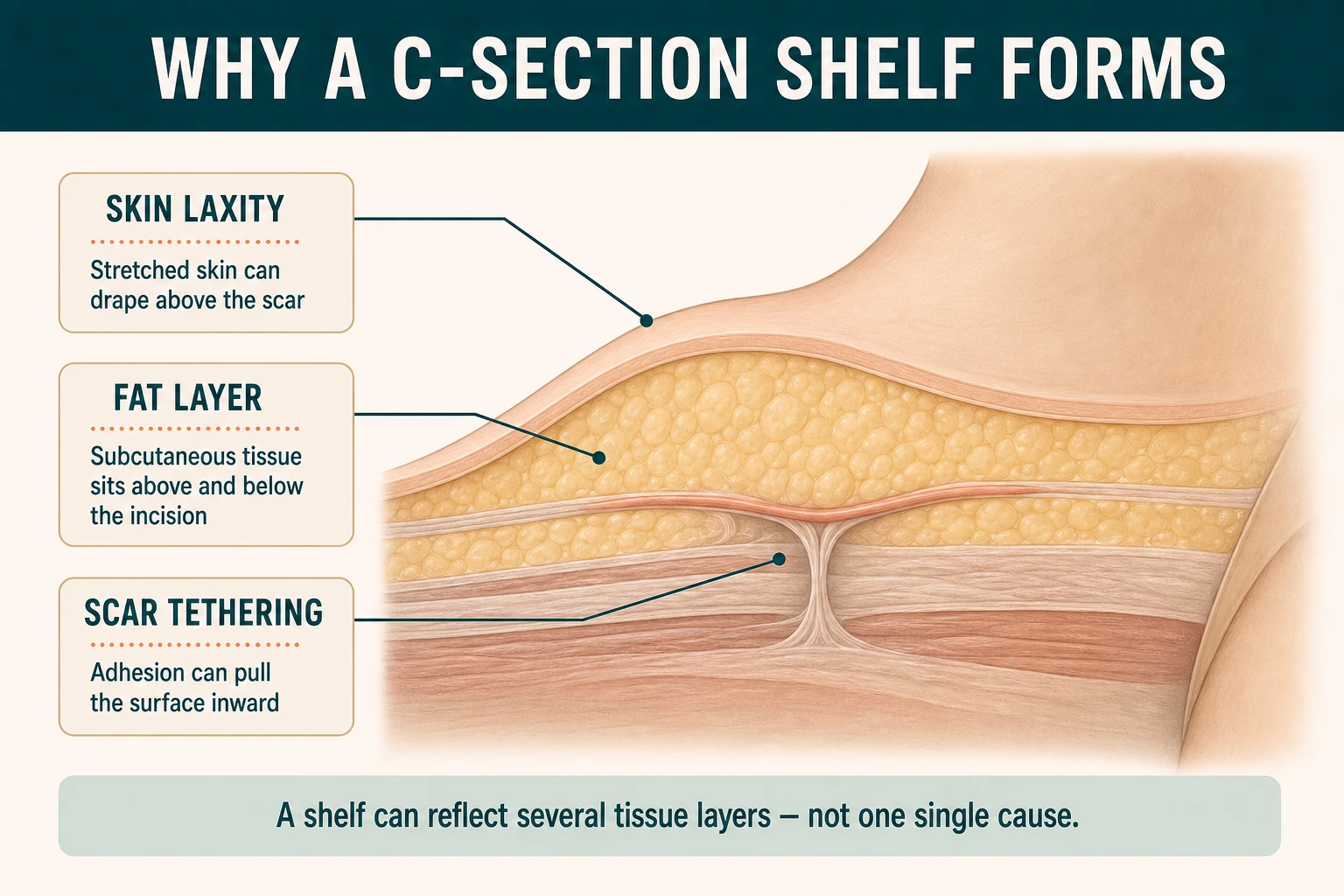
There is rarely a single cause. The shelf is usually the result of several overlapping factors working together. Here is what happens beneath the surface.
Scar Adhesion and Tethering
When the surgeon closes the uterine and abdominal layers, the body forms scar tissue between those layers as part of normal healing. In some women, this scar tissue adheres — meaning it binds the skin to the underlying fascia (the tough connective tissue covering the abdominal muscles). This adhesion pulls the scar line inward, creating an indentation that makes the tissue above it appear to bulge forward like a shelf.
The degree of adhesion varies widely. Some people develop little restriction; others develop firmer tethering after abdominal surgery. The cited systematic review concerns symptoms and soft-tissue mobilization for abdominal adhesions broadly; it does not quantify how often a repeat cesarean creates a visible shelf.2
Skin Laxity
Pregnancy stretches the abdominal skin significantly. Collagen and elastin fibers in the dermis can be damaged or permanently altered, particularly after large babies, multiples, or multiple pregnancies. After delivery, the skin may not retract fully to its pre-pregnancy state, leaving loose, softer skin that tends to fold at the scar line where adhesion holds it in place.
Genetics play a substantial role in how well skin rebounds. Age at the time of pregnancy is another factor: skin elasticity naturally decreases over time.3
Fat Distribution Changes
Hormonal changes during pregnancy and the postpartum period can shift where the body stores fat. The lower abdomen is a common area for increased fat deposition, and some of this fat may settle above the scar line, adding volume to the shelf. This is a hormonal and metabolic process — not a consequence of eating habits during pregnancy.
Abdominal Muscle Changes
Diastasis recti — a separation of the rectus abdominis (the “six-pack” muscles) along the midline — affects an estimated 33–60% of postpartum women.4 When these muscles are separated, the abdominal wall offers less support to the organs and tissue behind it, which can cause a bulge in the lower belly that compounds the shelf appearance.
The cesarean incision itself cuts through layers of tissue and temporarily weakens the lower abdominal wall, which can further contribute to a change in how the abdomen sits.
Is a C-Section Shelf Permanent?
Not necessarily. The appearance of the shelf often changes substantially during the first 12–18 months postpartum as:
- Swelling from surgery and pregnancy resolves (this alone can take 3–6 months)
- The scar matures and softens (scar remodeling continues for up to 2 years)
- Hormonal fluid retention normalizes
- Core strength is gradually restored
For some women, the shelf becomes barely visible after this natural healing period. For others — particularly those with significant adhesion, skin laxity, or multiple cesarean deliveries — the shelf remains noticeable even after the body has fully healed.
There is no universal timeline. Comparing your body to someone else’s at 6 months postpartum is comparing entirely different genetics, pregnancies, and healing patterns.
What Helps Without Surgery
This section is intentionally longer and more detailed than the surgical section. For most women, non-surgical approaches are the right starting point — and for many, they are the only intervention needed.
Time — The Most Underrated Factor
It is worth repeating: the body continues to heal and remodel scar tissue for up to 2 years after surgery. Many women assess their shelf at 3 or 6 months and feel discouraged. That timeline is far too early to make lasting judgments about the final result. Giving the body 12–18 months before evaluating options is widely recommended by both obstetricians and physical therapists.
Scar Mobilization and Massage
Once the incision is fully healed (typically 6–8 weeks postpartum, confirmed by your healthcare provider), scar mobilization can begin. This involves:
- Cross-friction massage: gentle, perpendicular pressure across the scar line, working to loosen adhesions between skin and fascia
- Skin rolling: lifting the skin away from the underlying tissue along the scar
- Multidirectional stretching: gently pulling the scar tissue in all directions to improve mobility
These techniques can be performed at home or guided by a physical therapist trained in postpartum care. Consistency matters more than intensity — 5 minutes daily over several months is more effective than aggressive sessions once a week.
Scar mobilization does not erase a scar. A systematic review of nine studies reported improvements in pain and function and, in some studies, scar mobility after soft-tissue mobilization for abdominal adhesions.2 The evidence was not specific enough to promise that massage will remove a cosmetic c-section shelf.
Core and Pelvic Floor Rehabilitation
Rebuilding core strength after cesarean delivery is not about doing crunches. In fact, traditional sit-ups and crunches can worsen diastasis recti if it is present. A structured postpartum core rehabilitation program typically includes:
- Diaphragmatic breathing: relearning how to engage the deep core (transverse abdominis) with breath
- Pelvic floor coordination: the pelvic floor and abdominal wall work as a unit; addressing one without the other is incomplete
- Progressive loading: gradually increasing core demands as the tissue heals and strengthens
APTA Pelvic Health provides pregnancy and postpartum physical therapy resources and a specialist locator.5 After medical clearance, a pelvic health physical therapist can individualize assessment and progression based on your symptoms, scar healing, and functional goals.
Weight Stability
Note: this section is about stability, not weight loss. Rapid weight fluctuations — in either direction — can affect the appearance of the lower abdomen and the shelf. Gradual return to a stable, healthy weight allows the skin and tissue to adapt more effectively.
Crash diets and extreme caloric restriction are not only ineffective for targeted fat loss (spot reduction is a myth), they can also compromise healing, particularly if you are breastfeeding. A balanced, nutrient-rich diet supports tissue repair and scar remodeling.
Supportive Garments
Some women find that postpartum support garments or abdominal binders provide comfort and help with posture during the early recovery period. There is limited evidence that compression garments change the long-term shape of the abdomen, but they may reduce swelling in the early weeks and provide a sense of support while core strength is being rebuilt.
These should be comfortable — not restrictive enough to impair breathing or pelvic floor function.
When to See a Doctor
The c-section shelf is cosmetic for most women, but there are situations where medical evaluation is appropriate:
- Pain or tenderness at the scar: persistent pain, especially with movement, can indicate nerve entrapment or problematic adhesions
- Skin irritation or infection: moisture can become trapped in the fold, leading to redness, rash, or fungal infection
- Numbness that does not improve: some nerve disruption is normal after cesarean delivery, but persistent numbness after 12 months warrants assessment
- Suspected hernia: a visible bulge that changes with coughing or straining may indicate an incisional hernia
- Significant diastasis recti: if the midline gap feels wider than 2 finger-widths, a physical therapist or physician should evaluate it
When Surgery Enters the Conversation
For some women, the c-section shelf remains after adequate time has passed and non-surgical approaches have been explored. In these cases, surgical options may become a reasonable part of the conversation — not because the shelf is a medical problem, but because the individual has decided the change meaningfully affects their quality of life.
Surgical approaches that can address the shelf include:
- C-section scar revision: addresses the scar itself and the adhesion pulling the skin inward; this is the most targeted option
- Mini abdominoplasty: removes excess skin and tightens the lower abdomen below the navel; appropriate when skin laxity is the primary issue
- Full abdominoplasty: addresses skin laxity, fat, and diastasis recti across the entire abdomen; this is a larger procedure with longer recovery
Important considerations before pursuing surgery:
- Most surgeons recommend waiting at least 12 months after delivery, and longer if you plan additional pregnancies
- A subsequent pregnancy will undo the results of abdominoplasty
- Surgery carries its own risks, including infection, scarring, and complications from anesthesia
- The American Society of Plastic Surgeons recommends consulting a board-certified plastic surgeon for an individualized assessment6
Surgery is a legitimate option. It is also never the only option, and it is never urgent. Taking time to fully explore non-surgical approaches first is not wasted time — it is good medical practice.
What Surgery Can and Can’t Do for a C-Section Shelf
Surgery is effective at some parts of the shelf and cannot touch others. Knowing the difference helps set realistic expectations before pursuing any procedure.
- Can fix: Excess loose skin (mini or full abdominoplasty removes it directly), the scar-adhesion indentation itself (scar revision releases the tethering), and localized fat above the scar line
- Can partially fix: Diastasis recti (muscle plication during an abdominoplasty repairs the separation, though it will not fully restore pre-pregnancy muscle tone in every case)
- Cannot fix: Stretch marks located above the treated area, skin quality changes unrelated to laxity (like texture or pigmentation), or numbness that has already become permanent
- Cannot guarantee: A completely flat, scar-free result — every surgical procedure leaves its own scar, though it typically sits lower and is easier to conceal than the original shelf
A board-certified plastic surgeon can examine your specific anatomy and tell you which of these apply to your case — general information here cannot substitute for that individual assessment.
Key Facts
- The c-section shelf is caused by scar adhesion, skin laxity, fat distribution changes, and muscle separation — not surgical error
- Scar tissue continues to remodel for up to 2 years after surgery
- Scar mobilization, core rehabilitation, and weight stability are the first-line approaches
- Approximately 32% of US births are cesarean deliveries
- Diastasis recti affects an estimated 33–60% of postpartum women
- Surgery is typically not recommended until at least 12 months postpartum and after non-surgical options have been explored
Frequently Asked Questions
Does a c-section shelf go away on its own?
In many women, the c-section shelf becomes less prominent over 12–18 months as swelling resolves and scar tissue matures. However, if the shelf is caused by scar adhesion pulling skin inward or significant skin laxity, it is unlikely to disappear completely without intervention.
What is the difference between a c-section shelf and a c-section pouch?
The terms are often used interchangeably. The “shelf” typically refers to the visible overhang of skin and tissue directly above the scar line, while “pouch” is a more general term for any soft tissue fullness in the lower abdomen after cesarean delivery. Both involve the same underlying factors: scar adhesion, skin laxity, and fat distribution changes.
Can scar massage help with a c-section shelf?
Yes. Scar mobilization, typically started 6–8 weeks postpartum once the incision is fully healed, can help release adhesions between the scar and underlying fascia. Physical therapists trained in postpartum care recommend gentle cross-friction and lifting techniques performed consistently over several months. This does not eliminate the shelf entirely, but it can reduce the tethered appearance.
Is a c-section shelf caused by a bad surgeon?
No. The shelf is a normal consequence of how the body heals from abdominal surgery, not an indicator of surgical skill. Factors like skin elasticity, body composition, number of cesarean deliveries, and individual healing patterns all play a larger role than surgical technique.
When is surgery the only option for a c-section shelf?
Surgery may be considered when the shelf causes persistent physical symptoms like skin irritation or hygiene difficulties, or when non-surgical approaches including scar therapy, core rehabilitation, and weight stability have been given adequate time (typically 12–18 months minimum) without meaningful improvement. The decision is personal and should involve a board-certified plastic surgeon.
Key Takeaways
- The c-section shelf is a common, normal result of cesarean delivery — not a surgical complication or a body “flaw”
- It is caused by a combination of scar adhesion, skin laxity, fat distribution, and abdominal muscle changes
- The body continues to heal for up to 2 years — early assessments are misleading
- Scar mobilization, core rehabilitation with a pelvic floor therapist, and weight stability are the recommended first steps
- Surgery is a legitimate option after non-surgical approaches have been fully explored, but it is never urgent
- See a doctor if you experience pain, skin irritation in the fold, persistent numbness, or signs of hernia
Sources
- American College of Obstetricians and Gynecologists. Safe Prevention of the Primary Cesarean Delivery (Obstetric Care Consensus No. 1). ACOG. 2014 (reaffirmed 2023).
- Wasserman JB, Copeland M, Upp M, et al. Effect of soft tissue mobilization techniques on adhesion-related pain and function in the abdomen: A systematic review. J Bodyw Mov Ther. 2019;23(2):262-269.
- Wollina U, Goldman A. Management of stretch marks (with a focus on striae rubrae). J Cutan Aesthet Surg. 2017;10(3):124-129.
- Sperstad JB, Tennfjord MK, Hilde G, et al. Diastasis recti abdominis during pregnancy and 12 months after childbirth: prevalence, risk factors and report of lumbopelvic pain. Br J Sports Med. 2016;50(17):1092-6.
- Academy of Pelvic Health Physical Therapy (APTA Pelvic Health). Pregnancy & Postpartum Physical Therapy. Accessed 2026.
- American Society of Plastic Surgeons. Tummy Tuck (Abdominoplasty). ASPS. 2024.