Swelling After a Mommy Makeover: Timeline & What Helps
Key Takeaway
Swelling after a mommy makeover is extensive, normal, and temporary. It peaks around days 3–5, resolves significantly by weeks 4–6, but residual swelling — especially in the lower abdomen — can persist for 3–6 months. The period between weeks 3–8 is often called “swell hell” because daily fluctuations make it impossible to judge your final result. Compression garments, gentle movement, hydration, and patience are your primary tools.
Why Swelling Happens
Surgical swelling (edema) is the body’s normal response to tissue trauma. When a mommy makeover involves abdominoplasty, the surgeon separates a large skin-and-fat flap from the underlying muscle, disrupting blood vessels and lymphatic channels. This causes fluid to accumulate in the tissue — and because the mommy makeover involves more tissue disruption than a single procedure, the swelling is more extensive.
The lymphatic system — your body’s drainage network — is temporarily disrupted and needs time to rebuild new pathways. This is why swelling is stubborn and resolves slowly, particularly in the lower abdomen where gravity pulls fluid downward.
Swelling Timeline
- Days 1–3: Swelling increases rapidly. You may look larger than before surgery. This is entirely normal.
- Days 3–5: Peak swelling. Your abdomen may feel tight and hard. Bruising spreads. This is the worst it will look.
- Weeks 1–2: Gradual improvement. Drains (if placed) help remove excess fluid. You’ll notice day-to-day changes.
- Weeks 3–6: Major swelling subsides. Your emerging shape becomes visible. But daily fluctuations begin — welcome to “swell hell.”
- Months 2–3: About 70–80% of swelling has resolved. Your shape is close to final but the lower abdomen may still be puffy, especially by end of day.
- Months 3–6: Residual swelling gradually resolves. The last area to fully deflate is typically the lower abdomen between the belly button and the incision line (the “pubic mound” area).
- Months 6–12: Final subtle refinements. Most women consider their result “final” around month 6, though very minor improvements can continue for up to a year, per the American Society of Plastic Surgeons.3
Swelling by Procedure Area
Because a mommy makeover combines multiple procedures, swelling does not behave identically everywhere on your body. Each area has its own timeline:
- Abdomen (tummy tuck): The most extensive and longest-lasting swelling. The lower abdomen, just above the incision, is typically the last area to fully settle — often taking the full 3–6 months. Firmness here is also common as internal tissues heal.
- Flanks and back (if liposuction is included): Swelling here tends to resolve faster than the abdomen, usually within 6–10 weeks, but can feel lumpy or uneven before it smooths out. Temporary contour irregularities during this phase are normal.
- Breasts (augmentation, lift, or reduction): Breast swelling typically peaks earlier (days 2–4) and resolves faster than abdominal swelling — most settles by 4–6 weeks, though implants can take 3–4 months to fully “drop and fluff” into their final position and shape.
- Belly button and upper incision line: Localized puffiness directly around the umbilicus is common and can be one of the more stubborn small pockets of swelling, sometimes visible even after the rest of the abdomen has flattened.
Because each area heals on its own timeline, it is normal for your abdomen to still look swollen while your breasts already look settled — this asymmetry in healing speed does not mean anything went wrong.
What “Swell Hell” Means
“Swell hell” is the term women use to describe the frustrating period — typically weeks 3–8 — when:
- Major swelling has subsided enough to see a shape emerging
- But residual swelling fluctuates unpredictably throughout the day
- You look great in the morning (after lying flat all night) and puffy by evening (after being upright and active)
- Certain activities, foods (salt), or even weather changes seem to trigger swelling spikes
- You can’t tell what your final result will look like
This is emotionally draining, especially when you’ve invested significant money, pain, and recovery time. The most important thing to understand: swell hell is completely normal and it ends. Every woman who has had this surgery goes through it. Your final result will not look like your swelling-day result.
What Makes Swelling Worse
- Too much activity — overdoing it triggers inflammatory swelling. The body is telling you to slow down.
- Standing or sitting for long periods — gravity pulls fluid downward; alternate between short walks and lying down with legs elevated.
- High sodium intake — salt causes water retention; minimize processed foods, restaurant meals, and added salt.
- Dehydration — paradoxically, not drinking enough water causes the body to retain more fluid.
- Heat — hot showers, baths, saunas, and hot weather increase blood flow to the skin and worsen swelling.
- Alcohol — causes vasodilation and fluid retention; avoid for at least 2–4 weeks.
- Hormonal fluctuations — menstrual cycle, particularly the week before your period, can amplify swelling.
What Helps Reduce Swelling
Compression Garments
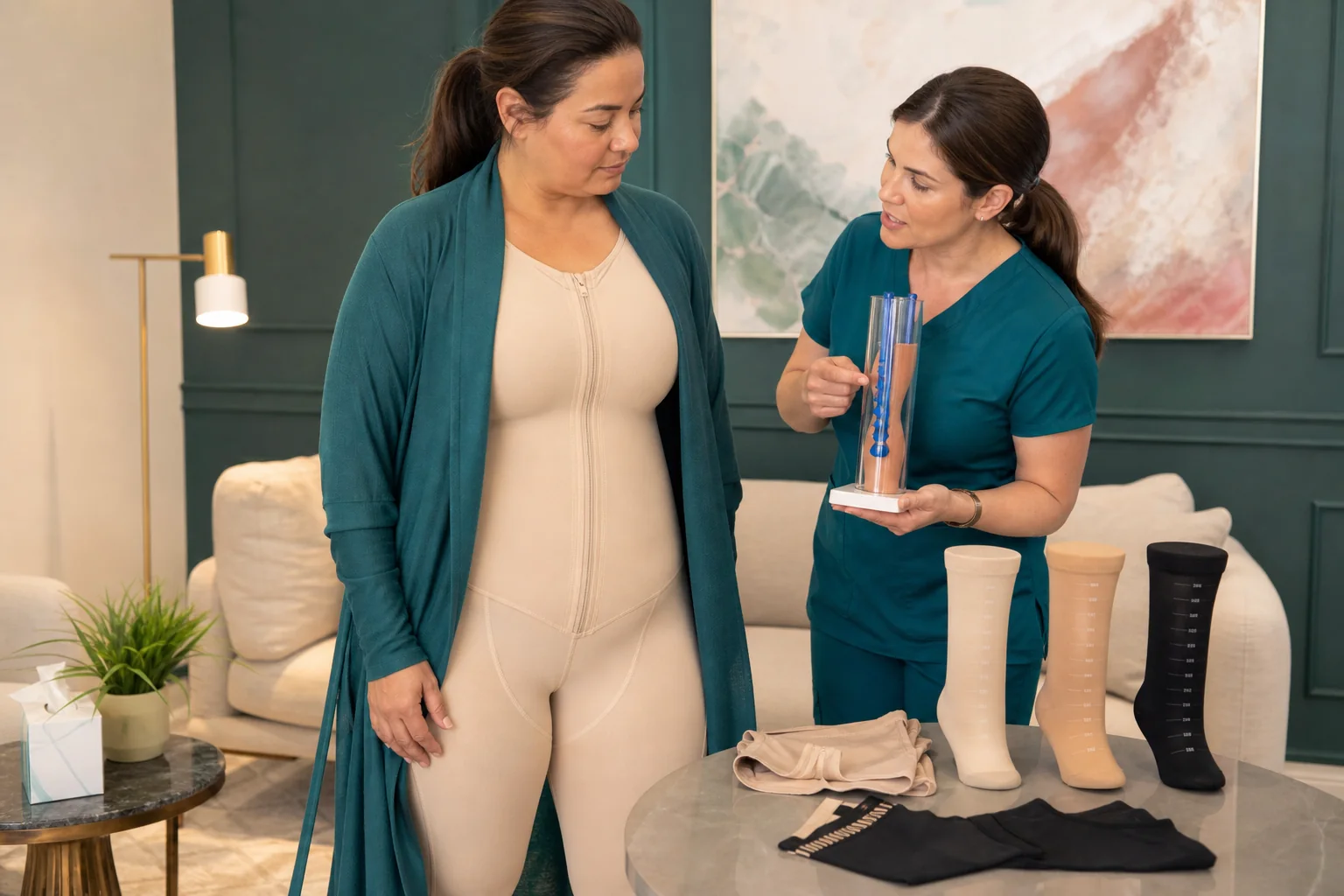
Compression garments are commonly prescribed after abdominoplasty, but the clinical evidence is limited. A 2024 systematic review found weak evidence and no clear, statistically significant improvement in the main post-abdominoplasty outcomes studied.1 Wear one only in the size, pressure level, and duration specified by your surgeon.
- Wear 23 hours/day for the first 4–6 weeks (remove only for showering)
- Transition to daytime-only wear for an additional 2–4 weeks
- Medical-grade compression is more effective than consumer shapewear
- You may need a smaller size as swelling decreases — a garment that’s too loose provides no benefit
Gentle Walking
Light walking promotes circulation and lymphatic drainage without triggering excess inflammation. Walk slowly and briefly multiple times per day rather than taking one long walk. This also reduces VTE risk.
Hydration
Drink at least 8–10 glasses of water daily. Adequate hydration helps the kidneys flush excess fluid. Dehydration causes the body to hold onto water, worsening swelling.
Elevation
When resting, lie with your upper body slightly elevated (wedge pillow or recliner position) and legs elevated on pillows. This encourages fluid to move away from the surgical area.
Low-Sodium Diet
Minimize salt intake for the first 4–6 weeks. Focus on whole foods, fresh vegetables and fruits (high in potassium, which counteracts sodium), lean protein, and plenty of water. Avoid processed foods, fast food, canned soups, and restaurant meals.
Lymphatic Massage (Manual Lymphatic Drainage)
Some surgeons recommend professional lymphatic drainage after surgery. One small study of 18 patients found less pain, swelling, and tissue fibrosis after a combined program of manual lymphatic drainage plus therapeutic ultrasound, but it cannot establish the effect of massage alone.2 Timing must be cleared by your surgeon, and any therapist should be trained in post-surgical care; deep-tissue massage over healing tissue may be unsafe.
Tracking Your Progress Realistically
Because swelling fluctuates so much day to day, judging your progress from the mirror alone is unreliable and can fuel unnecessary anxiety. A few practical habits make tracking more accurate:
- Photograph at the same time, same lighting, same pose — ideally first thing in the morning before any activity, salt, or fluids have caused daily swelling to build up.
- Compare week-to-week, not day-to-day. Daily comparisons are dominated by noise (last night’s meal, how long you were upright); weekly comparisons reveal the true healing trend.
- Avoid comparing your timeline to other patients’ online. Swelling resolution speed varies with body type, activity level, procedure combination, and individual healing biology — a friend’s faster timeline does not mean something is wrong with yours.
- Keep a simple symptom log noting swelling, activity, sodium intake, and how you felt — this helps you and your surgeon distinguish normal fluctuation from a genuine change in trend.
When Swelling Is a Warning Sign
Normal swelling is bilateral (roughly equal on both sides) and gradually improves. Contact your surgeon if you notice:
- Sudden increase in swelling on one side — may indicate hematoma (blood collection) or seroma (fluid collection)
- Asymmetric leg swelling — swelling in one leg more than the other, especially with calf pain, is a warning sign of blood clot (DVT) — contact your surgeon immediately
- Swelling with redness, warmth, and fever — may indicate infection
- Swelling that dramatically worsens after weeks of improvement — may indicate seroma or other complication
Frequently Asked Questions
-
Major swelling resolves within 4–6 weeks. Residual swelling in the lower abdomen can persist for 3–6 months. Most women see 80–90% of their final result by month 3.
-
The period (weeks 3–8) when swelling fluctuates unpredictably — looking good in the morning and puffy by evening. It’s emotionally frustrating but completely normal and temporary.
-
Yes. Compression garments reduce swelling by supporting tissues and improving lymphatic drainage. Wear 23 hours/day for 4–6 weeks, then daytime-only for 2–4 more weeks. Medical-grade garments provide better compression than consumer shapewear.
-
Concerning signs include sudden one-sided swelling (hematoma/seroma), asymmetric leg swelling with calf pain (possible blood clot), swelling with redness and fever (infection), or dramatic worsening after weeks of improvement.
-
Generally yes. Combining a tummy tuck with breast surgery and/or liposuction disrupts more tissue and lymphatic pathways than a single procedure, which is why mommy makeover recovery is often longer than recovery from any one component alone. Each area still follows its own individual timeline.
-
Very light self-massage may be approved by your surgeon after the initial healing period, but professional manual lymphatic drainage from a therapist trained in post-surgical care is safer and more effective in the early weeks. Never use deep-tissue techniques or massage devices without your surgeon's clearance.
Key Takeaways
- Swelling peaks at days 3–5 and resolves significantly by weeks 4–6.
- Residual lower abdominal swelling can persist for 3–6 months.
- “Swell hell” (weeks 3–8) is emotionally draining but completely normal and temporary.
- Compression garments, hydration, low-sodium diet, and gentle walking are your best tools.
- Asymmetric swelling, especially in one leg, requires immediate medical attention.
- Your final result will not look like your swelling-day result — be patient.
Sources
- Arkoubi AY. Effect of Compression Garments on Post-Abdominoplasty Outcomes: A systematic Review of the current Evidence. JPRAS Open. 2024;41:128-137.
- Masson IF, de Oliveira BD, Machado AF, et al. Manual lymphatic drainage and therapeutic ultrasound in liposuction and lipoabdominoplasty post-operative period. Indian J Plast Surg. 2014;47(1):70-6.
- American Society of Plastic Surgeons. Tummy Tuck Recovery. ASPS. 2024.