
Breasts After Breastfeeding: What Changes and Why
Key Takeaway
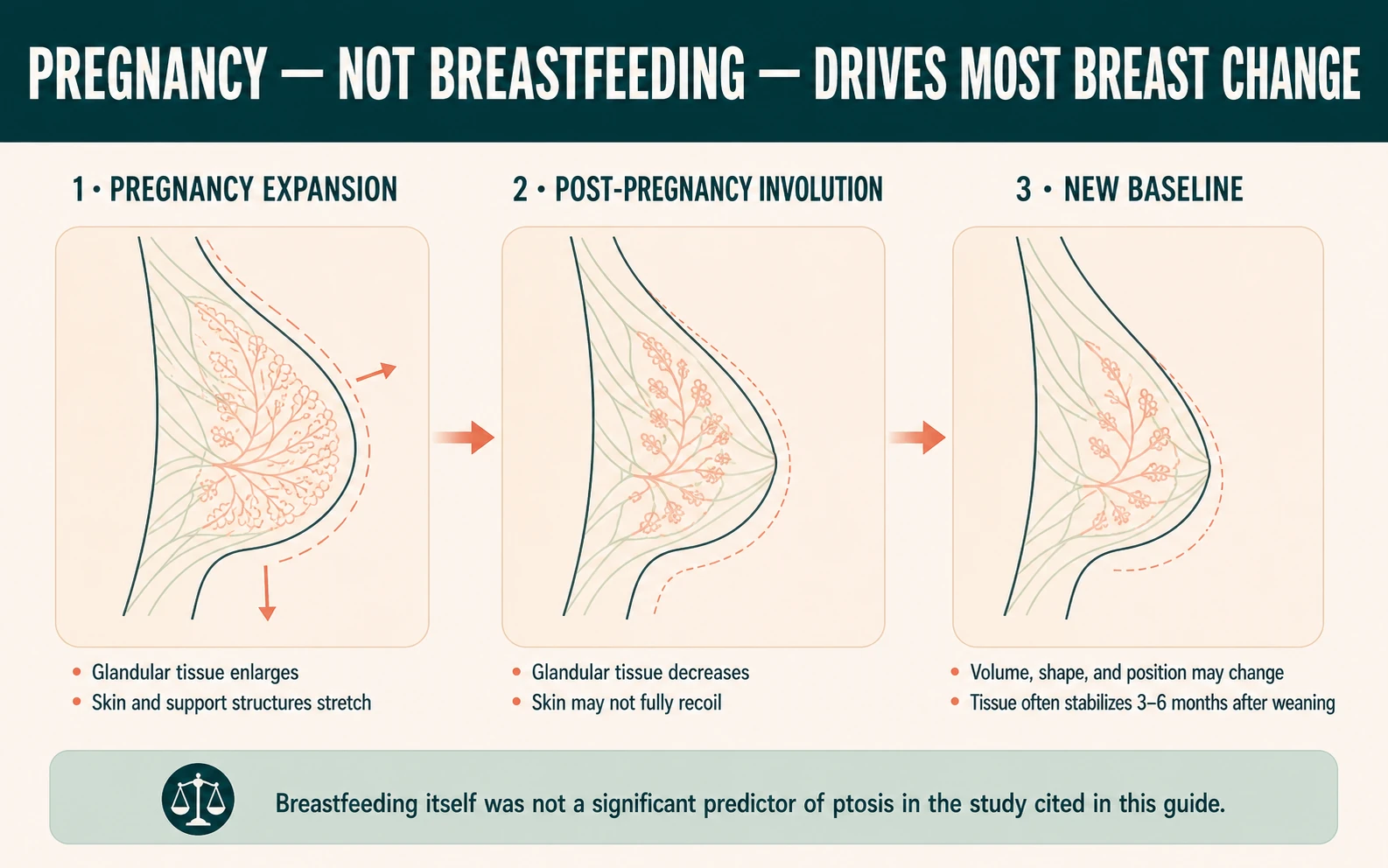
The most common myth about breasts after breastfeeding is that breastfeeding causes sagging. Research consistently shows it does not. Pregnancy itself — along with age, genetics, and smoking — drives the changes in breast shape and volume. Understanding this matters for both informed decisions and guilt-free breastfeeding.
The Breastfeeding Myth: What Actually Causes Breast Changes
One of the most persistent myths in women’s health is that breastfeeding causes breasts to sag. This belief influences breastfeeding decisions, creates unnecessary guilt, and is not supported by the evidence.
A widely cited 2008 study published in the Aesthetic Surgery Journal examined risk factors for breast ptosis (sagging) in 132 women seeking breast surgery. The researchers found that the number of pregnancies, higher BMI, larger pre-pregnancy bra size, smoking history, and age were all significant predictors of breast ptosis. Breastfeeding, including duration of breastfeeding, was not a significant risk factor, according to Rinker et al.1
This finding has been supported by subsequent research. The changes attributed to breastfeeding are actually caused by the hormonal and physical effects of pregnancy itself:
- Hormonal breast expansion: during pregnancy, estrogen and progesterone cause the mammary glands to enlarge and the breast to increase significantly in size. This expansion stretches the skin and Cooper’s ligaments (the internal support structures of the breast)
- Post-pregnancy involution: after pregnancy (and after weaning, if breastfeeding), the glandular tissue shrinks back down. But the stretched skin and ligaments do not always retract fully, resulting in a “deflated” appearance
- Repeated cycles: each pregnancy repeats this expansion-contraction cycle, adding cumulative stress to the support structures
This means that a woman who has two pregnancies and does not breastfeed will experience the same type of breast changes as a woman who breastfeeds both children. The pregnancy, not the feeding method, drives the change.
Volume Loss vs. Sagging (Ptosis): Two Different Things
Postpartum breast changes generally fall into two distinct categories — volume loss and ptosis (sagging) — and they don’t always occur together. Knowing which one you actually have (or whether it’s both) matters because each is addressed differently if treatment is ever considered.
Volume Loss
Many women notice that their breasts feel “emptied out” or flatter after pregnancy and nursing. This occurs because the glandular tissue that expanded during pregnancy and lactation involutes (shrinks back) after weaning. If the fatty tissue of the breast has also decreased — which can happen with postpartum weight changes — the breast loses overall volume.
Volume loss is most noticeable in the upper pole of the breast (the upper half, above the nipple), creating a slope or concavity where the breast previously had fullness.
Ptosis (Sagging)
Ptosis is classified by the position of the nipple relative to the inframammary fold (the crease beneath the breast). The more the nipple descends below this fold, the greater the degree of ptosis. Breast ptosis after pregnancy is caused by stretching of Cooper’s ligaments and skin during the expansion phase, as described in Kirwan’s ptosis classification system.2
Ptosis and volume loss often occur together, but they are different issues. A breast can lose volume without sagging (looking deflated but still positioned well), or it can sag while retaining volume (positioned lower but still full).
Changes in Symmetry
Some degree of breast asymmetry is normal and present in most women before pregnancy. Pregnancy and breastfeeding can sometimes exaggerate pre-existing asymmetry, particularly if one breast produced more milk or was favored during nursing. In most cases, symmetry improves after weaning as the breast tissue stabilizes.
Nipple and Areola Changes
The areola often darkens during pregnancy due to hormonal effects on melanocytes. While some of this color change reverses after delivery, the areola may remain slightly larger or darker than before pregnancy. Nipple shape can also change, particularly after prolonged breastfeeding.
How Long to Wait After Weaning
Breasts after breastfeeding do not reach their final baseline immediately after weaning. It typically takes 3–6 months for the glandular tissue to fully involute and for the breast to settle into its new shape and volume. During this transition period:
- Breasts may feel soft, empty, or uneven as milk production shuts down
- Hormonal changes (particularly the rise in estrogen as prolactin decreases) can cause temporary fluid retention and breast sensitivity
- The final shape and volume may be different from what you see at 2 weeks or 2 months post-weaning
For this reason, it is important not to make any lasting assessments — or surgical decisions — in the immediate weeks after stopping breastfeeding. Give the tissue time to stabilize.
Non-Surgical Options
There are limited non-surgical interventions for breasts after breastfeeding. Honest expectations are important.
Properly Fitted Bras
A well-fitted bra can significantly improve the appearance and comfort of breasts that have changed in size or shape. Many women are wearing the wrong bra size after pregnancy because their measurements have changed. A professional fitting can help. While a bra does not change breast tissue, it provides external support that affects how breasts look in clothing.
Chest Wall Exercises
Exercises that strengthen the pectoral muscles (chest press, push-ups, chest flies) can improve the appearance of the upper chest and provide a slightly lifted look. These exercises do not change the breast tissue itself — breasts are primarily fat and glandular tissue, not muscle — but a stronger chest wall creates a firmer platform beneath the breast, as the American College of Obstetricians and Gynecologists notes.3
Weight Stability
Significant weight fluctuations after pregnancy can worsen breast changes. Gaining weight may increase breast volume but also adds to stretching; losing weight may reduce volume and increase the deflated appearance. A stable, healthy weight gives the breast tissue the best chance to settle.
Skin Care
Moisturizing and sun protection support skin health on the chest, but no topical product can lift or add volume to the breast. Avoid products that make claims about “breast firming” — these are not supported by evidence.
Normal vs When to See a Doctor
Post-breastfeeding breast changes are almost always benign, but routine breast awareness matters — and a small set of signs needs prompt evaluation regardless of how recently you weaned.
| Usually normal | See a doctor promptly |
|---|---|
| Gradual volume loss and softening as milk-producing tissue involutes | Any new distinct lump that persists through a full menstrual cycle |
| Some degree of drooping (ptosis) or change in shape | Spontaneous nipple discharge, especially if bloody or from a single duct |
| Occasional tenderness or fibrocystic feel with your cycle | New skin dimpling, puckering, or orange-peel (peau d’orange) texture |
| Mild asymmetry between the two breasts | New nipple retraction that was not there before pregnancy |
| Some numbness or altered sensation around the nipple | One-sided persistent pain, redness, warmth, or swelling |
Postpartum breast awareness is part of routine care — ask your OB-GYN or primary care provider to include a clinical breast exam at your postpartum visit, and follow your country’s screening guidelines for mammography once you are back in that age band.
Surgical Options Within the Mommy Makeover Context
When non-surgical approaches do not address the changes that matter to you, surgical options for breasts after breastfeeding exist. Within the context of a mommy makeover, breast procedures are commonly combined with abdominal surgery.
Breast Augmentation
Implants restore volume to breasts that have deflated after pregnancy. Augmentation addresses volume loss but does not correct significant ptosis. The American Society of Plastic Surgeons reports that breast augmentation is one of the most commonly performed cosmetic procedures in the US.4
Breast Lift (Mastopexy)
A mastopexy reshapes and lifts the breast by removing excess skin and repositioning the nipple to a higher location. It addresses ptosis but does not add volume. For women with both ptosis and volume loss, augmentation and mastopexy can be combined.
Breast Reduction
Some women find that their breasts remain larger after pregnancy than they were before, or that the added weight causes back and shoulder pain. Breast reduction removes tissue and reshapes the breast. It is both a cosmetic and a functional procedure.
Timing Considerations
- Wait at least 3–6 months after completely stopping breastfeeding
- Achieve and maintain a stable weight
- Consider whether you plan additional pregnancies (pregnancy changes the breasts again and may undo surgical results)
- Ensure milk production has fully ceased before surgery
Can You Breastfeed After Breast Surgery?
This is a critical question for women who may want more children after breast surgery. The answer depends on the procedure:
- Augmentation (submuscular placement): generally preserves breastfeeding ability because the implant is placed behind the pectoral muscle, away from the glandular tissue and milk ducts, as confirmed by a systematic review and meta-analysis5
- Mastopexy (breast lift): techniques that preserve the nipple’s pedicle (its connection to the glandular tissue) usually allow breastfeeding, though there may be some reduction in supply
- Reduction: carries the highest risk of disrupting milk ducts and nerve supply to the nipple, which can significantly reduce or eliminate breastfeeding ability
If future breastfeeding is important to you, discuss this specifically with your surgeon before any breast procedure. Technique selection can be influenced by breastfeeding goals.
Key Facts
- Research shows breastfeeding does not cause breast ptosis — pregnancy, age, smoking, and genetics do
- Breast tissue takes 3–6 months after weaning to fully stabilize
- Volume loss and ptosis are different changes that may need different approaches
- Chest exercises strengthen the pectoral muscles beneath the breast but do not change breast tissue
- Breast augmentation, lift, or reduction can be combined within a mommy makeover
- Breastfeeding ability can be preserved after many breast surgeries depending on technique
Frequently Asked Questions
Does breastfeeding cause saggy breasts?
Research shows that breastfeeding itself does not cause breast ptosis (sagging). A landmark 2008 study in the Aesthetic Surgery Journal found that the number of pregnancies, pre-pregnancy breast size, BMI, smoking status, and age were significant predictors of breast ptosis — but breastfeeding was not. The changes are caused by pregnancy hormones and the physical expansion and contraction of breast tissue, regardless of whether you breastfeed.
Will my breasts go back to normal after breastfeeding?
Breast changes after pregnancy are variable. Some women see their breasts return close to their pre-pregnancy appearance, while others experience persistent changes in volume, shape, or position. It typically takes 3–6 months after weaning for the breast tissue to fully settle into its new baseline. The final result depends on genetics, age, the number of pregnancies, and the degree of tissue expansion during pregnancy.
What is the difference between volume loss and ptosis?
Volume loss means the breast has less tissue (fat and glandular tissue) than before, resulting in a deflated or flattened appearance. Ptosis (sagging) means the breast tissue has descended below the natural crease, with the nipple pointing downward. Many women experience both, but they are different changes that may require different approaches if treatment is desired.
How long should I wait after breastfeeding before considering breast surgery?
Most surgeons recommend waiting at least 3–6 months after completely stopping breastfeeding. This allows breast tissue to fully stabilize in its new volume and shape, gives hormones time to normalize, and ensures milk production has completely ceased. If you are planning additional pregnancies, it is generally advisable to wait until you are done having children, as pregnancy will change the breasts again.
Can I breastfeed after breast surgery?
It depends on the type of surgery. Breast augmentation with implants placed behind the muscle generally preserves breastfeeding ability. Breast lift (mastopexy) techniques that preserve the nipple’s connection to the underlying glandular tissue usually allow breastfeeding, though there may be some reduction in milk supply. Breast reduction carries a higher risk of affecting breastfeeding. Discuss your future breastfeeding plans with your surgeon before any procedure.
Key Takeaways
- Breastfeeding does not cause breast sagging — pregnancy, age, genetics, and smoking are the actual drivers
- Breast changes include volume loss, ptosis, asymmetry, and nipple/areola changes — often in combination
- Wait 3–6 months after weaning for breast tissue to fully stabilize before assessing the final result
- Non-surgical options are limited: properly fitted bras, chest exercises, and weight stability can help with comfort and appearance
- Breast augmentation, lift, and reduction are well-established surgical options when the time is right
- Breastfeeding after surgery is possible with many techniques — discuss this with your surgeon if future pregnancies are planned
Sources
- Rinker B, Veneracion M, Walsh CP. Breast ptosis: causes and cure. Ann Plast Surg. 2010;64(5):579-84.
- Kirwan L. A classification and algorithm for treatment of breast ptosis. Aesthet Surg J. 2002;22(4):355-63.
- American College of Obstetricians and Gynecologists. Physical Activity and Exercise During Pregnancy and the Postpartum Period. ACOG Committee Opinion No. 804. 2020.
- American Society of Plastic Surgeons. Breast Augmentation. ASPS. 2024.
- Schiff M, Algert CS, Ampt A, et al. The impact of cosmetic breast implants on breastfeeding: a systematic review and meta-analysis. Int Breastfeed J. 2014;9:17.