
Mommy Makeover Cost: US vs Turkey
Key Takeaway
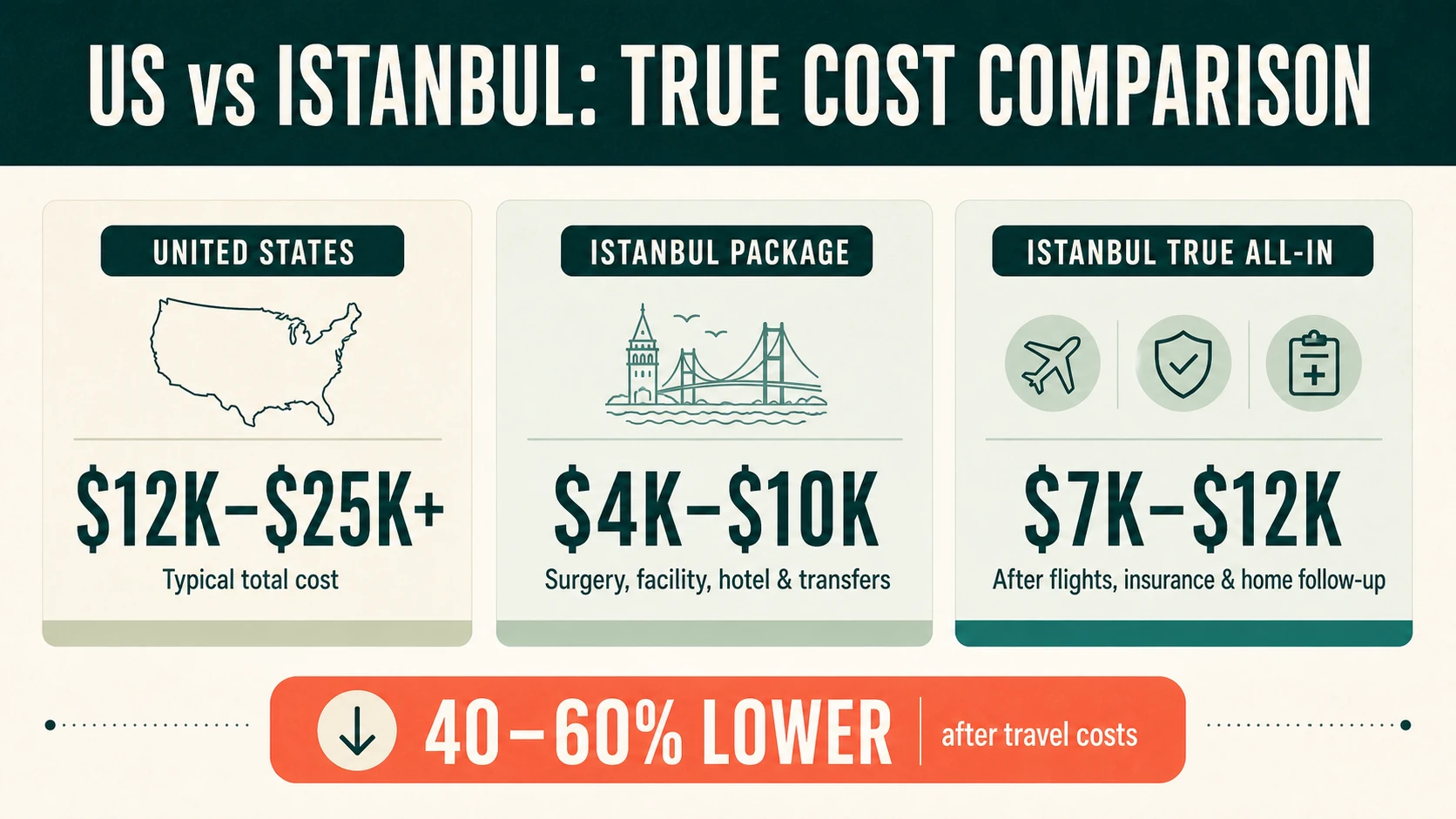
A mommy makeover in Turkey costs roughly 40–60% less than in the US, even after adding travel expenses. But the savings come with real trade-offs: a follow-up gap when you return home, limited recourse if complications arise, and the need to vet surgeons in a market with significant quality variation. The cost difference is genuine — the question is whether the trade-offs are acceptable for your situation.
The Headline Numbers
| United States | Turkey package | |
|---|---|---|
| Typical all-in combined mommy makeover | $12,000–$25,000 | $4,000–$10,000 |
US combination-by-combination ranges are published once on the 2026 cost breakdown and are not reprinted here. Turkey package figures above are advertised surgical-plus-hospitality totals, not an apples-to-apples match for the US all-in bill.
Based on ASPS statistics, US figures represent total costs (surgeon + anesthesia + facility + implants).1 Turkey figures represent typical all-inclusive package prices (surgeon + anesthesia + facility + hotel + transfers). Neither figure includes airfare, travel insurance, or home-country follow-up.
Why Turkey Is Cheaper
The price difference is driven by economics, not quality shortcuts:
- Lower cost of living — surgeon salaries, facility overhead, nursing wages, and implant costs are all substantially lower in Turkey than in the US
- Currency advantage — the Turkish lira has significantly weakened against the US dollar, making services priced in lira very affordable for dollar-paying patients
- Volume-based practices — many Turkish surgeons operate on far more patients per year than their US counterparts, which spreads fixed costs across more cases
- Government investment — Turkey has invested heavily in medical tourism infrastructure, with JCI-accredited hospitals that meet international standards
- Lower malpractice insurance — medical liability insurance in Turkey is a fraction of US costs, which are some of the highest in the world
None of these factors inherently compromise surgical quality. According to ISAPS global survey data, Turkey ranks among the top countries worldwide for aesthetic procedures performed.2 Istanbul has world-class plastic surgeons trained at top institutions. But the low prices also attract providers who prioritize volume over patient safety — and that distinction is critical.
What the Turkey Price Doesn’t Include
When you see a $5,000 mommy makeover package, understand what’s not in that number:
| Additional Cost | Estimated Range |
|---|---|
| Round-trip airfare (US to Istanbul) | $600 – $1,500+ |
| Travel health insurance | $100 – $300 |
| Companion airfare (if not traveling alone) | $600 – $1,500+ |
| Extended hotel stay (if complications delay departure) | $100 – $200/night |
| Follow-up care with a local surgeon at home | $200 – $500 per visit |
| Revision surgery (if needed, at home) | $5,000 – $15,000+ |
| Complication management at home | Variable — potentially thousands |
| Lost wages (extended travel time) | Variable |
When you add airfare, insurance, and realistic follow-up costs, a $5,000 Turkey package becomes $7,000–$9,000. That’s still substantially less than the US — but the gap narrows. And it narrows dramatically if you need revision surgery at home.
The Follow-Up Gap: The Real Risk
This is the most important consideration in any medical travel decision, and it applies to all destinations, not just Turkey.
After a mommy makeover, your surgeon needs to see you at regular intervals: typically day 1, day 3–5 (drain removal), week 2, week 6, month 3, and month 6. When you fly home 7–10 days after surgery, you lose continuity of care with the surgeon who knows your anatomy and what was done.
A 2023 systematic review of aesthetic-surgery tourism complications identified 589 patients who presented after procedures abroad; infection was most common, followed by wound dehiscence, seroma or hematoma, and tissue necrosis.4 The review also highlights short- and long-term follow-up and the management and cost of complications as patient-safety concerns. Before travel, obtain a written plan for who will assess you at home, what the overseas clinic will cover, and who pays for tests, drainage, admission, or revision if a problem occurs.
For a comprehensive understanding of the risks involved in combined procedures, see our detailed guide on combined-procedure risk.
Quality Variation in Turkey’s Market
Turkey’s plastic surgery market is vast and quality ranges widely:
- Top tier: Board-certified plastic surgeons (Turkish Board of Plastic, Reconstructive and Aesthetic Surgery) operating in internationally accredited hospitals, verified through ACS-style accreditation and verification standards, with appropriate case selection and safety protocols3
- Middle tier: Competent surgeons in private clinics that may lack international accreditation but maintain reasonable standards
- Bottom tier: High-volume operators (sometimes not board-certified plastic surgeons) working in unaccredited facilities, prioritizing throughput and marketing over patient safety
The challenge for international patients is distinguishing between these tiers from abroad. Instagram results, patient coordinator promises, and rock-bottom prices are not reliable quality indicators. Read our guide to choosing a qualified surgeon for verification steps that apply in any country.
Making a Fair Comparison
If you’re seriously comparing US vs. Turkey, here’s a framework for an honest assessment:
| Factor | US | Turkey |
|---|---|---|
| Total cost (including all expenses) | $12,000 – $25,000+ | $7,000 – $12,000 (true all-in) |
| Follow-up care | Same surgeon, local | Remote after 7–10 days |
| Complication management | Same surgeon’s responsibility | Must find local surgeon at home |
| Revision surgery | Often discounted by original surgeon | Full price with a new surgeon at home |
| Legal recourse | US malpractice system | Limited international recourse |
| Travel burden | None to minimal | 10–14 days away from home/kids |
| Surgeon vetting | ABPS verification, state licensing | Requires more independent research |
When Turkey Makes Sense
Medical travel to Turkey can be a reasonable choice for women who:
- Have thoroughly researched and vetted a specific board-certified surgeon (not just a clinic brand)
- Can afford the trip and have a financial reserve for potential complications or revision at home
- Have a support person who can travel with them
- Can arrange childcare for 2–3 weeks (travel + initial recovery at home)
- Understand and accept the follow-up gap
- Have identified a local plastic surgeon willing to provide post-operative care after return
When Turkey Doesn’t Make Sense
- When cost is the only reason — choosing a surgeon based on price is dangerous in any country
- When you have health risk factors that increase complication probability (obesity, diabetes, smoking history, prior abdominal surgery)
- When you cannot afford complications or revision at home if something goes wrong
- When you cannot arrange adequate childcare and time away
- When the combination of procedures would result in operative times exceeding 5–6 hours
Frequently Asked Questions
-
Turkey packages typically cost $4,000–$10,000, compared to $12,000–$25,000+ in the US. Turkey packages usually include hotel and transfers. The real all-in cost difference narrows to 40–60% once you add flights, insurance, and home-country follow-up.
-
Turkey has excellent board-certified surgeons and JCI-accredited hospitals. However, quality varies widely. Safety depends on the specific surgeon, facility accreditation, and whether evidence-based safety protocols for combined procedures are followed.
-
Airfare ($600–$1,500+), travel insurance, companion travel, extended stay for complications, home-country follow-up care, potential revision surgery, and lost wages for extended travel time.
-
You’ll need a local plastic surgeon willing to manage another surgeon’s work — which many are reluctant to do. ER care is covered by your domestic insurance, but revision surgery and ongoing complication treatment are out-of-pocket and potentially more expensive than the original procedure.
-
Set aside a cash reserve beyond the package price — enough for an extended hotel stay, a local follow-up visit, and at least a portion of a worst-case revision surgery at home, which can run $5,000–$15,000 or more with a new surgeon. Booking with zero financial cushion leaves you exposed if anything goes wrong.
Key Takeaways
- Turkey mommy makeover packages cost 40–60% less than the US, even after adding travel expenses.
- The Turkey price typically excludes airfare, travel insurance, home-country follow-up, and revision costs.
- The follow-up gap is the most significant trade-off — complications at home require finding a new surgeon.
- Quality varies widely in Turkey’s medical tourism market — vetting the specific surgeon is essential.
- Budget for complications: revision surgery at home can exceed the original Turkey procedure cost.
- The right choice depends on your individual risk factors, support system, and financial reserves — not just price.
Sources
- American Society of Plastic Surgeons. Plastic Surgery Statistics. ASPS. 2024.
- International Society of Aesthetic Plastic Surgery. ISAPS Global Survey on Aesthetic/Cosmetic Procedures. ISAPS. 2023.
- American College of Surgeons (ACS). Accreditation and Verification Programs. facs.org. Accessed 2026.
- Alkaelani MT, Koussayer B, Blount T, et al. Complications of Medical Tourism in Aesthetic Surgery: A Systematic Review. Ann Plast Surg. 2023;91(6):668-673.