
Mommy Makeover Cost in Turkey: What’s Really Included
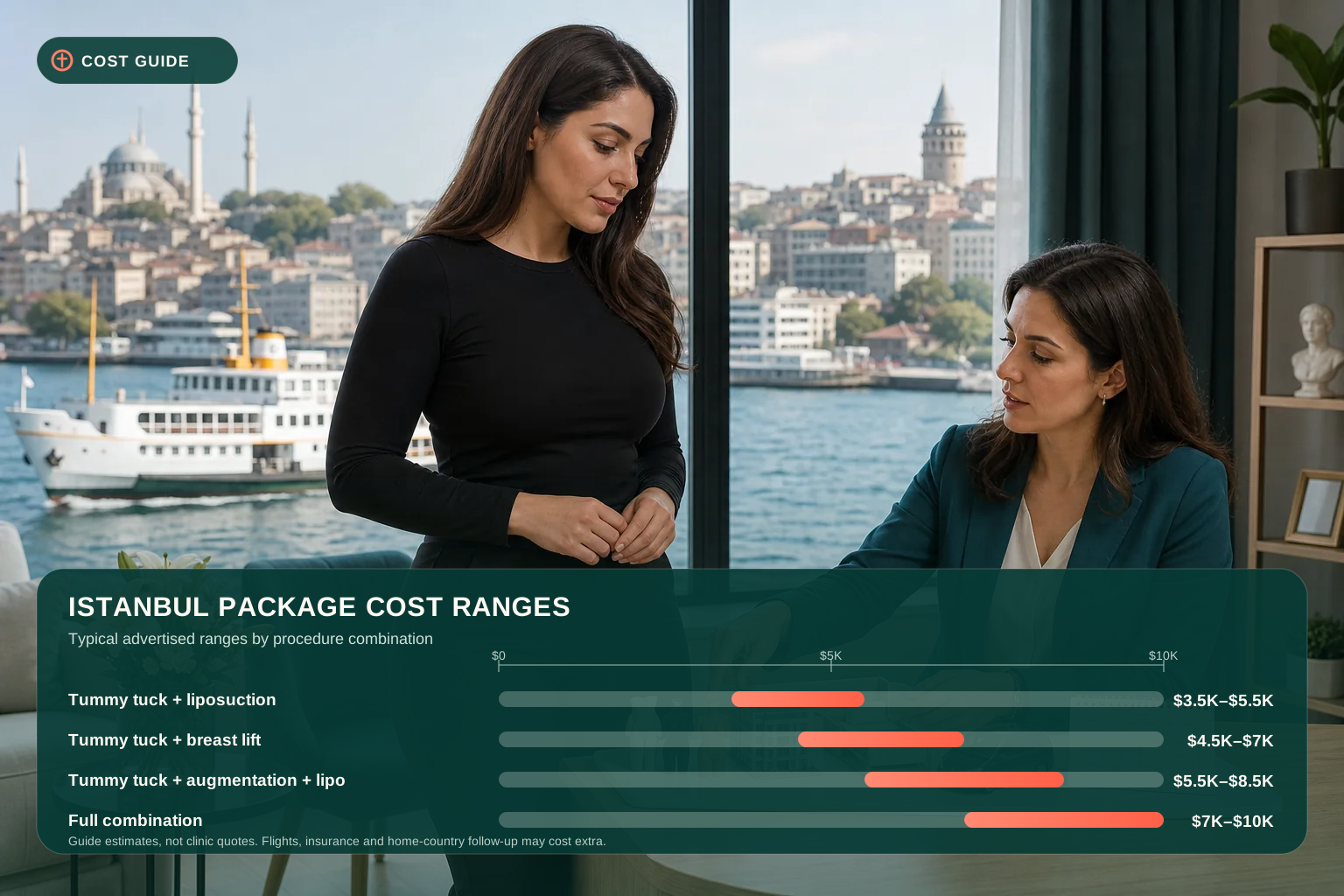
- Mommy makeover packages in Turkey typically range from $4,000 to $10,000 — compared to $12,000–$25,000+ in the US.
- Standard packages usually include surgeon fees, hospital stay (1–3 nights), hotel, and airport transfers.
- Flights, travel insurance, compression garments, medications, and revision surgery are almost never included.
- The largest hidden cost is the follow-up gap: managing complications after you return home can be expensive and logistically difficult.
- Always request an itemized written quote and compare at least three providers before committing.
- Lower price does not automatically mean lower quality — but it also does not guarantee equivalent aftercare.
Mommy makeover packages in Turkey generally cost between $4,000 and $10,000 for the surgical package. This is significantly less than the US average of $12,000–$25,000+, but the advertised price rarely tells the full story. Flights, extended hotel stays, medications, and — critically — any revision or complication management after your return home are almost always additional expenses.
What Do Turkish Packages Actually Cost?
Prices vary based on the number of procedures combined, the hospital tier, and the surgeon’s credentials. The table below is Turkey package pricing only. US combination totals are published once on the 2026 US cost breakdown ($12,000–$25,000 all-in) and are not repeated here.
| Combination | Typical Turkey package |
|---|---|
| Tummy tuck + liposuction | $3,500–$5,500 |
| Tummy tuck + breast lift | $4,500–$7,000 |
| Tummy tuck + breast augmentation + lipo | $5,500–$8,500 |
| Full combination (abdomen + breast + contouring) | $7,000–$10,000 |
These ranges reflect what clinics advertise as package prices. Your actual total will depend on the specifics of your case, the number of areas treated, and how long you need to stay.
What Packages Typically Include
Most Turkish mommy makeover packages bundle several services into one price. A standard “all-inclusive” package usually covers:
- Surgeon fees — the operating surgeon and any assisting physicians
- Anesthesia — general anesthesia administered by a board-certified anesthesiologist
- Hospital stay — typically 1–3 nights in a private room
- Pre-operative lab work — blood tests and sometimes an ECG
- Hotel accommodation — usually 5–7 nights at a partner hotel
- Airport and hospital transfers — car service between airport, hotel, and hospital
- Post-op check-ups — in-person follow-ups while you are still in Istanbul
This bundling is part of what makes the pricing attractive — in the US, surgeon fees, anesthesia, and facility fees are typically billed separately, and hotel is never part of the equation.
What Packages Do NOT Include
This is where the real cost picture becomes more complicated. The following expenses are almost never covered by a Turkish surgery package:
- Round-trip flights — expect $600–$1,500 from major US cities
- Travel insurance — medical travel insurance with surgical complication coverage ($100–$400)
- Compression garments — post-surgical garments ($80–$250)
- Prescription medications — pain management, antibiotics, anti-nausea
- Extra hotel nights — if recovery takes longer than planned (common)
- Revision surgery — if results require correction; policies vary wildly
- Complication management at home — ER visits, local surgeon consultations, antibiotics, or drainage after returning to the US
- Companion travel costs — a travel companion is strongly recommended; their flights, meals, and hotel add up
The follow-up gap is the most significant hidden cost. If a complication arises after you fly home — a seroma, wound dehiscence, infection — you will need to find a local surgeon willing to manage another surgeon’s work, often at premium rates. This can add $2,000–$10,000+ to your total cost.
How to Compare Quotes Properly
When you receive quotes from multiple providers, an apples-to-apples comparison requires asking the right questions:
- Get an itemized breakdown — never accept a single lump-sum quote without knowing what each line item covers.
- Ask about the hospital — is it a JCI-accredited hospital or an outpatient clinic? The safety profile is different.
- Clarify the surgeon’s role — will the quoted surgeon perform the entire operation, or will parts be delegated?
- Ask about revision policy — what happens if you need a revision? Is it covered? For how long? Who pays for travel?
- Confirm the hotel tier — a “5-star hotel” claim varies enormously. Ask for the hotel name and look it up independently.
- Request the total out-of-pocket estimate — including flights, insurance, garments, medications, and a buffer for extra nights.
A package quoted at $5,000 with flights ($1,000), insurance ($200), garments ($150), medications ($100), companion costs ($1,500), and a two-day buffer ($300) actually totals closer to $8,250. That is still significantly less than a US price — but the gap narrows more than the headline number suggests.
Why Is It Cheaper? The Real Reasons
The cost difference is not primarily about surgeon skill. Several structural factors drive prices down in Turkey:
- Lower operating costs — staff salaries, rent, and facility costs are lower than in the US
- Currency advantage — the Turkish lira has depreciated significantly against the US dollar
- Volume-based model — many clinics perform high volumes of cosmetic procedures, spreading fixed costs
- Government support — Turkey actively promotes medical tourism as an economic strategy
- Intense competition — hundreds of clinics compete for international patients, driving prices down
None of these factors inherently compromise quality. According to the ISAPS Global Survey, Turkey ranks among the top countries worldwide for cosmetic procedures performed.3 Some Turkish hospitals meet the same accreditation standards as top US facilities. But the volume-based model can also mean less individualized attention, shorter consultation times, and a production-line approach at lower-tier facilities. Due diligence matters.
Cost Savings vs. Safety Trade-offs
The cost advantage is real, but it should never be the only factor in your decision. A mommy makeover is major surgery — typically 4–7 hours under general anesthesia combining abdominoplasty with breast surgery and sometimes liposuction.
Key considerations beyond price:
- Combined procedures carry higher complication rates than single procedures, according to Winocour et al.1
- Flying 10–12 hours within 10–14 days of major surgery increases venous thromboembolism (VTE) risk, as validated by Pannucci et al.2
- Post-operative follow-up in your home country may be difficult to arrange and expensive
- Revision surgery, if needed, may require a second trip to Turkey or a US surgeon at full price
For a detailed safety analysis, see our guide: Is a Mommy Makeover in Istanbul Safe?
How Payment and Deposits Typically Work
Most Turkish hospitals and clinics ask for a deposit to confirm your surgery date, with the remainder due on arrival or before discharge. Understanding this process helps you avoid surprises and protects you if you need to cancel or postpone.
- Deposit amount — typically 10–30% of the package price, paid by bank transfer or card after your consultation is confirmed
- Balance due — usually collected in cash or by card at the hospital before or immediately after surgery, not after you have had time to evaluate results
- Refund policy — ask in writing what happens if you cancel, if your surgeon changes, or if your surgery date is postponed for medical reasons
- Currency of payment — quotes are often given in US dollars or euros but settled in Turkish lira; ask whether the exchange rate is locked at the time of quoting or at the time of payment
- Payment plans — some clinics offer installment financing through third-party lenders; read the interest terms carefully, as rates on medical tourism financing can be high
A written contract or confirmation email that itemizes the deposit, balance, and refund terms is a basic form of consumer protection. If a clinic is unwilling to put payment terms in writing, treat that as a warning sign rather than a formality to skip.
Red Flags in Pricing
Price alone does not tell you whether a package is a good deal or a poor one. A handful of pricing patterns are worth treating with caution:
- Prices far below the advertised market range — if most quotes cluster around $5,000–$8,000 for a given combination and one clinic quotes $2,500, ask what is different: shorter hospital stay, less experienced surgeon, or an outpatient facility instead of an accredited hospital
- Pressure to pay a deposit immediately — legitimate providers give you time to compare quotes and ask follow-up questions before asking for money
- Vague line items — a quote that just says “all-inclusive” without breaking out surgeon fees, hospital fees, and accommodation makes it hard to compare against other offers or to know what you are actually paying for
- Upselling after arrival — some patients report being told additional procedures or extended stays are “needed” only once they are already in Istanbul, at a point where negotiating leverage is limited
- No clarity on the operating facility — a quote should specify the exact hospital or accredited surgical facility, not just a clinic brand name that outsources the actual operation elsewhere
None of this means low prices are inherently suspicious — competition genuinely does keep prices lower in Turkey than in the US. The point is to verify what a price includes before assuming it represents the same standard of care as a more expensive quote.
Frequently Asked Questions
-
Most packages range from $4,000 to $10,000 depending on the combination of procedures, surgeon experience, and hospital. This typically includes surgeon fees, anesthesia, hospital stay, and transfers.
-
Standard packages typically include surgeon fees, anesthesia, operating room, 1–3 nights hospital stay, hotel accommodation, airport transfers, and pre-operative lab work. Flights, compression garments, and medications are usually extra.
-
Yes. Flights, travel insurance, extra hotel nights if recovery takes longer, prescription medications, compression garments, and any revision surgery are almost never included. Always ask for a written breakdown before committing.
-
Lower operating costs, currency differences, and intense competition among clinics drive prices down. Surgeon training and hospital standards can be comparable, but lower cost does not automatically mean equivalent follow-up care or recourse if complications arise.
-
Some clinics offer installment plans through third-party lenders, and most require a deposit of 10–30% to confirm your surgery date with the balance due on arrival. Always get deposit, balance, and refund terms in writing, and read any financing interest terms carefully before signing.
-
If a quote is well below the typical market range, ask what is different — shorter hospital stay, a less experienced surgeon, or a non-accredited outpatient facility rather than a hospital. Request an itemized breakdown and confirm the exact operating facility before assuming a low price reflects the same standard of care.
Sources
- Winocour J, Gupta V, Ramirez JR, et al. Abdominoplasty: Risk Factors, Complication Rates, and Safety of Combined Procedures. Plast Reconstr Surg. 2015;136(5):597e-606e.
- Pannucci CJ, Bailey SH, Dreszer G, et al. Validation of the Caprini risk assessment model in plastic and reconstructive surgery patients. J Am Coll Surg. 2011;212(1):105-12.
- ISAPS. ISAPS Global Survey on Aesthetic/Cosmetic Procedures. International Society of Aesthetic Plastic Surgery. 2023.