How to Read Mommy Makeover Before-and-After Photos
Key Takeaway
Mommy makeover before-and-after photos are powerful but can be misleading without context. Results vary significantly based on the combination performed, starting anatomy, skin quality, and healing time. Photos taken at 3 months still show residual swelling; final results take 6-12 months. Scars are part of every result. Stretch marks largely remain. Understanding these realities helps you set accurate expectations — which research shows is the strongest predictor of post-surgical satisfaction.
Why Results Vary Between Patients
No two mommy makeover results are identical, even when the same procedures are performed by the same surgeon. Understanding why helps calibrate your expectations:
Different Combinations
A patient who underwent tummy tuck plus breast lift plus liposuction will look very different from one who had only a tummy tuck. When comparing results, always confirm which procedures were actually performed. A mommy makeover is an individualized combination rather than a fixed operation, as the American Society of Plastic Surgeons explains.1
Starting Anatomy
Two patients with identical combinations can have very different results because they started in different places:
- Skin quality: A patient with good skin elasticity will have smoother contours than one with thin, photo-damaged, or heavily stretch-marked skin.
- Degree of muscle separation: Repairing severe diastasis recti (4+ cm gap) produces a more dramatic improvement in profile than repairing mild separation.
- Body fat distribution: Where your body stores fat affects how liposuction and abdominoplasty combine to reshape your silhouette.
- Tissue volume: Breast results depend heavily on existing tissue — a patient with adequate breast tissue can achieve excellent shape with a lift alone, while one with very little tissue may need implants for comparable fullness.
Healing and Biology
Genetics influence how you scar, how quickly swelling resolves, and how your tissues settle. Two people can follow identical post-operative protocols and heal differently. Age, nutrition, and overall health also play roles in healing quality.
How to Read Before & After Photos Critically
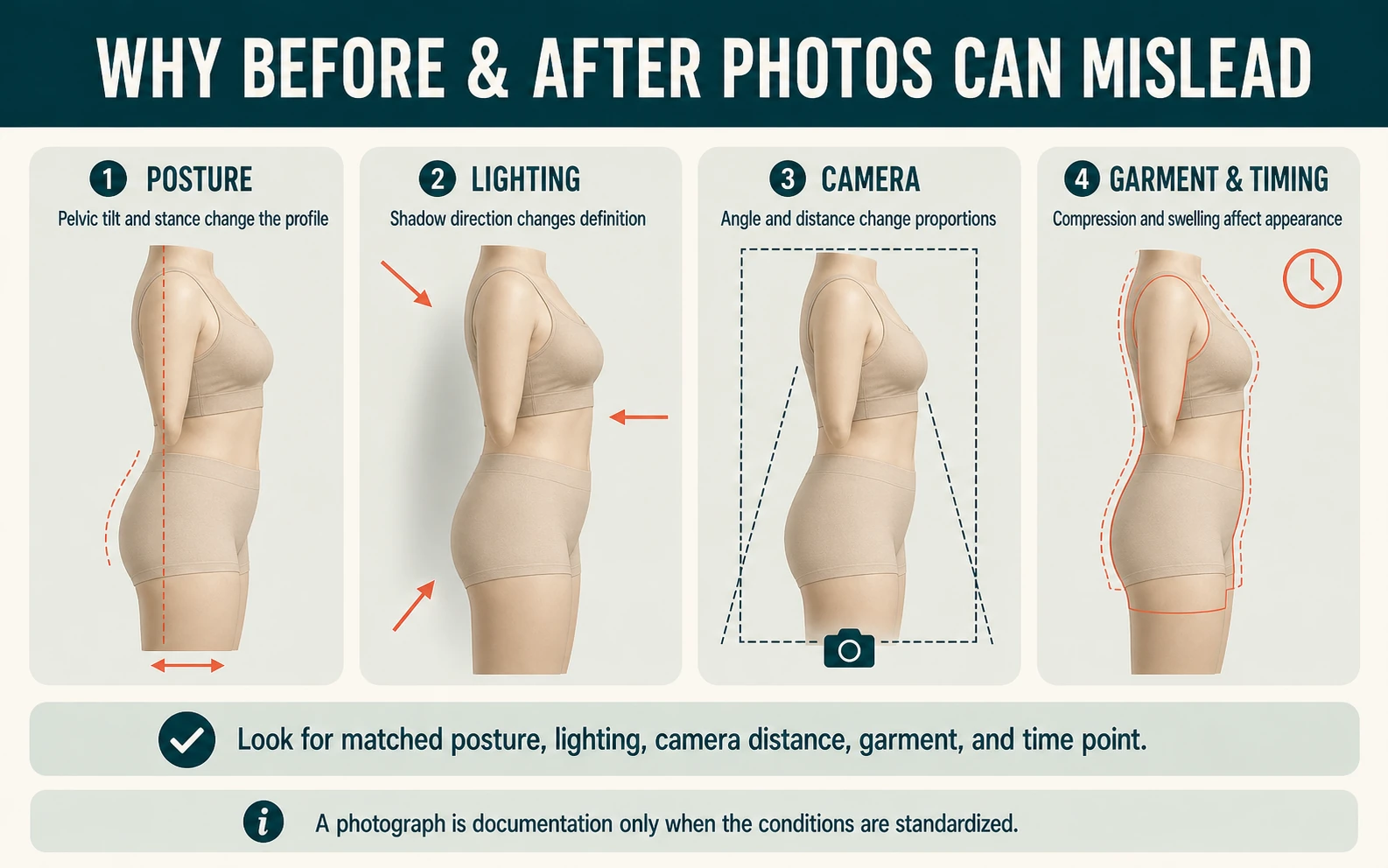
Before-and-after galleries are a surgeon's portfolio — they naturally show the best results under the best conditions. To evaluate them fairly, look for these details:
Consistency Checks
- Lighting: Is the lighting identical in both photos? Harsh overhead light creates shadows that exaggerate contour; soft frontal light minimises it. Different lighting between before and after is a red flag.
- Pose and angle: Are the body positions identical? A slight rotation, hip tilt, or arm position change can dramatically alter how the abdomen, waist, and breasts appear.
- Distance from camera: Photos taken from different distances distort proportions. A closer after photo makes the subject appear larger; a further one makes them appear smaller.
- Clothing/garments: Is the after photo showing the patient in a compression garment? These smooth the silhouette and do not represent the unclothed result.
- Skin tone: Tanning between photos can make skin appear smoother and more even, masking texture irregularities.
Timing
This is perhaps the most important factor. Ask (or look for labels indicating) when the after photo was taken:
- 3 months post-op: Still significant residual swelling, especially in the lower abdomen. Shape is emerging but not final. Scars are still red/pink.
- 6 months post-op: Most swelling has resolved. Shape is approximately 90% final. Scars beginning to fade.
- 12+ months post-op: Final result. Scars mature (pale). Implants fully settled. Tissue softened.
A 3-month photo may look slightly better than the true final result because mild swelling can create the appearance of fullness and smooth minor contour irregularities that become visible once all swelling resolves.
What Is Not Shown
Galleries typically show front and side views. They rarely show:
- Scars at close range (particularly the hip-to-hip tummy tuck scar)
- The patient bending or sitting (where skin folds differently)
- Asymmetries (which exist in virtually all results to some degree)
- The patient in different clothing types
These omissions are not necessarily deceptive — they are standard photographic protocol. But recognising what is absent helps you maintain realistic expectations.
The Timeline Behind the Photos: Months of Settling
The transformation you see in photos represents a journey that unfolds over many months. Understanding this timeline prevents anxiety during your own recovery:
Week 1-2: The Swollen Phase
Immediately post-surgery, swelling is significant. The abdomen appears larger than expected. Breasts sit high and feel stiff. This is entirely normal and not representative of the result. Photos from this period would look alarming to someone unfamiliar with the process.
Week 3-6: Early Shaping
Major swelling begins to resolve. The general contour emerges. You can see the direction of the result, but significant swelling (especially in the lower abdomen and mons pubis) persists. Bruising fades.
Month 2-3: Visible Improvement
Approximately 70-80% of swelling has resolved. The shape is recognisable. Breast implants (if placed) begin their "drop and fluff" — descending from their initially high position into a more natural shape. Many surgeons take comparison photos at this stage.
Month 4-6: Refinement
Residual lower abdominal swelling resolves. Skin continues to retract and soften. Scars transition from raised/red to flattening/pink. Sensation returns to areas of temporary numbness.
Month 6-12: Final Result
Scars mature to their final state (pale lines in most patients). Tissue fully softens. Contours are definitive. This is when the most accurate before-and-after comparison can be made, as outlined in ASPS recovery guidance.2
Patience Is Part of the Process
Many patients experience a frustrating period around weeks 4-8 where swelling fluctuates (worse in evenings or after activity), progress seems to stall, and the gap between their expectation and current appearance feels large. This is a normal part of the healing arc. Comparing to other patients' results at this stage is particularly unhelpful because you are comparing your mid-recovery to their final result.
Scars Are Part of the Result
Every mommy makeover produces permanent scars. This is a reality that deserves honest discussion, not minimisation:
Typical Scar Locations
- Abdominoplasty: Hip-to-hip incision (low, following the bikini line) plus a circular scar around the navel. This is the most significant scar.
- Breast lift: Around the areola (always), plus a vertical line to the fold (for lollipop technique), plus a horizontal fold incision (for anchor/inverted-T technique).
- Breast augmentation only: Small incision in the fold, around the areola, or in the axilla.
- Liposuction: Small (5-8 mm) stab incisions at entry points — usually hidden in natural creases.
Scar Evolution
Scars go through a predictable maturation process:
- Month 1-3: Red, raised, sometimes firm. This is the most visible stage.
- Month 3-6: Transitioning to pink, beginning to flatten. Still noticeable.
- Month 6-12: Fading to pale pink or white. Flattening significantly.
- Year 1-2: Final state — typically a pale, flat line in fair-skinned patients. Darker skin types may develop hyperpigmentation or slight keloid/hypertrophic scarring.
Scar quality varies enormously between patients. Genetics is the primary determinant. Some patients develop barely visible lines; others develop wider, more noticeable scars despite identical surgical technique and aftercare, as detailed in a BMJ review of skin scarring.3
Managing Expectations
A helpful framework: expect visible scars and be pleasantly surprised if they fade well — rather than expecting invisible scars and being disappointed when they are visible. Your surgeon can discuss scar management options (silicone sheets, SPF protection, possibly laser treatment later) but cannot guarantee scar quality.
What Surgery Does Not Change
Setting realistic expectations requires understanding what remains even after excellent surgery:
Stretch Marks Largely Remain
Only stretch marks on skin that is physically cut away (excised) during abdominoplasty are eliminated. This means:
- Stretch marks below the navel and above the pubic area — often removed with the excised skin panel
- Stretch marks above the navel — remain (the skin is pulled down but the marks travel with it)
- Stretch marks on hips, thighs, breasts, flanks — completely unaffected by surgery
If stretch mark removal is a primary goal, it is important to understand these limitations before surgery. The improvement is in contour and skin tightness — not in skin texture.
Skin Texture and Quality
Surgery tightens and repositions skin but does not change its fundamental texture, pore size, crepe-like quality (if present), or sun damage. The skin you have is the skin that is reshaped — just with less laxity.
Natural Asymmetry
All bodies have some degree of asymmetry. Surgery can improve symmetry but rarely achieves perfection. One breast will likely remain slightly different from the other. One side of the abdomen may heal marginally differently. This is normal human anatomy, not a surgical failure.
Weight Distribution Patterns
If you gain weight after surgery, your body will still store fat in its genetically-determined pattern. Liposuction removes fat cells permanently from treated areas, but remaining cells can still enlarge. Untreated areas may become more prominent if weight is gained.
Longevity: How Long Do Results Last?
Mommy makeover results are permanent in the sense that removed skin does not regrow, repaired muscles stay repaired (unless disrupted), and excised fat cells do not regenerate. However, results can change over time:
Future Pregnancy
The most significant threat to results. A subsequent pregnancy will stretch muscles, expand skin, and change breasts — potentially reversing much of the surgical improvement. This is why being done having children is a primary candidacy criterion.
Weight Fluctuation
Gaining 10-15+ pounds after surgery can stretch the tightened skin, expand remaining fat cells, and alter contours. The surgical result creates a better framework, but that framework still responds to weight changes. Maintaining a stable weight preserves results long-term, as demonstrated in a prospective outcome study of 360 patients.4
Ageing
Skin continues to age. Over decades, some laxity will return due to normal collagen loss and gravity. A well-performed tummy tuck at age 35 will still look excellent at 45, good at 55, and gradually soften over further decades — but will always look better than if surgery had never been performed.
Breast Implants (If Placed)
Implants are not lifetime devices. Average lifespan is 10-20 years. Capsular contracture, rupture, or desire for size change may necessitate revision. A breast lift without implants has more durable results because there is no prosthesis to maintain.
Realistic Longevity Expectations
| Component | Expected Longevity | Main Threat |
|---|---|---|
| Muscle repair (diastasis) | Permanent (unless pregnancy) | Future pregnancy |
| Abdominoplasty contour | 10-15+ years excellent | Weight gain, ageing |
| Breast lift | 10-15 years before gravity effects | Weight change, ageing |
| Breast implants | 10-20 years (then revision likely) | Capsular contracture, rupture |
| Liposuction | Permanent fat cell removal | Remaining cells enlarge with weight gain |
Setting Expectations: The Satisfaction Research
A prospective BREAST-Q study of 611 breast-augmentation patients found large postoperative improvements in satisfaction and psychosocial and sexual well-being, while physical well-being remained below baseline at six weeks and six months.5 It is useful evidence for discussing benefits and recovery tradeoffs, but it does not show that expectation accuracy is the single strongest predictor across all body-contouring procedures.
Patients who understood what surgery could and could not achieve, who expected scars, who knew recovery would take months, and who had realistic timelines for final results reported significantly higher satisfaction than patients with excellent objective outcomes but unrealistic prior expectations.
This means that the work you are doing right now — researching, understanding limitations, learning to read photos critically — is directly contributing to your future satisfaction with whatever decision you make.
Frequently Asked Questions
Final results take 6-12 months to fully manifest. At 6 weeks you see the general shape; at 3 months approximately 80% of the result is visible; at 6 months swelling is largely resolved; at 12 months scars have matured and breast implants (if placed) have fully settled. Photos taken at 3 months still show residual swelling.
Only stretch marks on skin that is physically excised (removed) during abdominoplasty will be eliminated. Stretch marks above the navel, on the hips, breasts, or thighs will remain. Surgery does not change skin texture or remove stretch marks from areas that are not cut away.
Results vary because each patient has different starting anatomy, different procedure combinations, different skin quality and healing capacity, and different body compositions. Two patients with the same combination can have very different results due to tissue quality, age, genetics, and adherence to post-operative care.
A subsequent pregnancy will stretch the repaired muscles and skin, likely compromising the abdominal result. Breast changes from pregnancy and lactation will also affect breast surgery results. The results are not completely reversed but are significantly diminished. This is why being done having children is a primary candidacy criterion.
Look for consistent lighting, similar poses, same distance from camera, and note the time post-surgery. Be skeptical of photos with different lighting, angles, tanning, or compression garments visible. Ask what stage of healing the after photo represents. Ideally, after photos should be at least 6 months post-op for accurate representation.
Key Takeaways
- Results vary dramatically based on starting anatomy, procedure combination, skin quality, and healing biology.
- Evaluate before-and-after photos for consistent lighting, pose, distance, and timing — ask when the after photo was taken.
- Final results take 6-12 months to fully manifest; 3-month photos still show residual swelling.
- Scars are permanent and a normal part of every result — expect them and be pleased if they fade well.
- Stretch marks are only removed where skin is excised; surgery does not change skin texture globally.
- Long-term results depend on weight stability, not having future pregnancies, and natural ageing — not just surgical technique.
Sources
- American Society of Plastic Surgeons. Mommy Makeover. ASPS. Accessed 2026.
- American Society of Plastic Surgeons. Tummy Tuck Recovery. ASPS. 2024.
- Bayat A, McGrouther DA, Ferguson MW. Skin scarring. BMJ. 2003;326(7380):88-92.
- Swanson E. Prospective outcome study of 360 patients treated with liposuction, lipoabdominoplasty, and abdominoplasty. Plast Reconstr Surg. 2012;129(4):965-978.
- Alderman AK, Bauer J, Fardo D, et al. Understanding the effect of breast augmentation on quality of life: prospective analysis using the BREAST-Q. Plast Reconstr Surg. 2014;133(4):787-795.