
Stretch Marks After Pregnancy: What Actually Fades
Key Takeaway
Stretch marks are permanent changes to the skin’s structure caused by collagen and elastin rupture during rapid stretching. They fade significantly over 12–24 months from red/purple to pale or silvery, but they do not disappear. No cream prevents them. Some treatments (laser, microneedling) can improve their appearance moderately. Surgery removes only the marks on excised skin. Genetics are the biggest factor in who gets them.
Why Stretch Marks Form
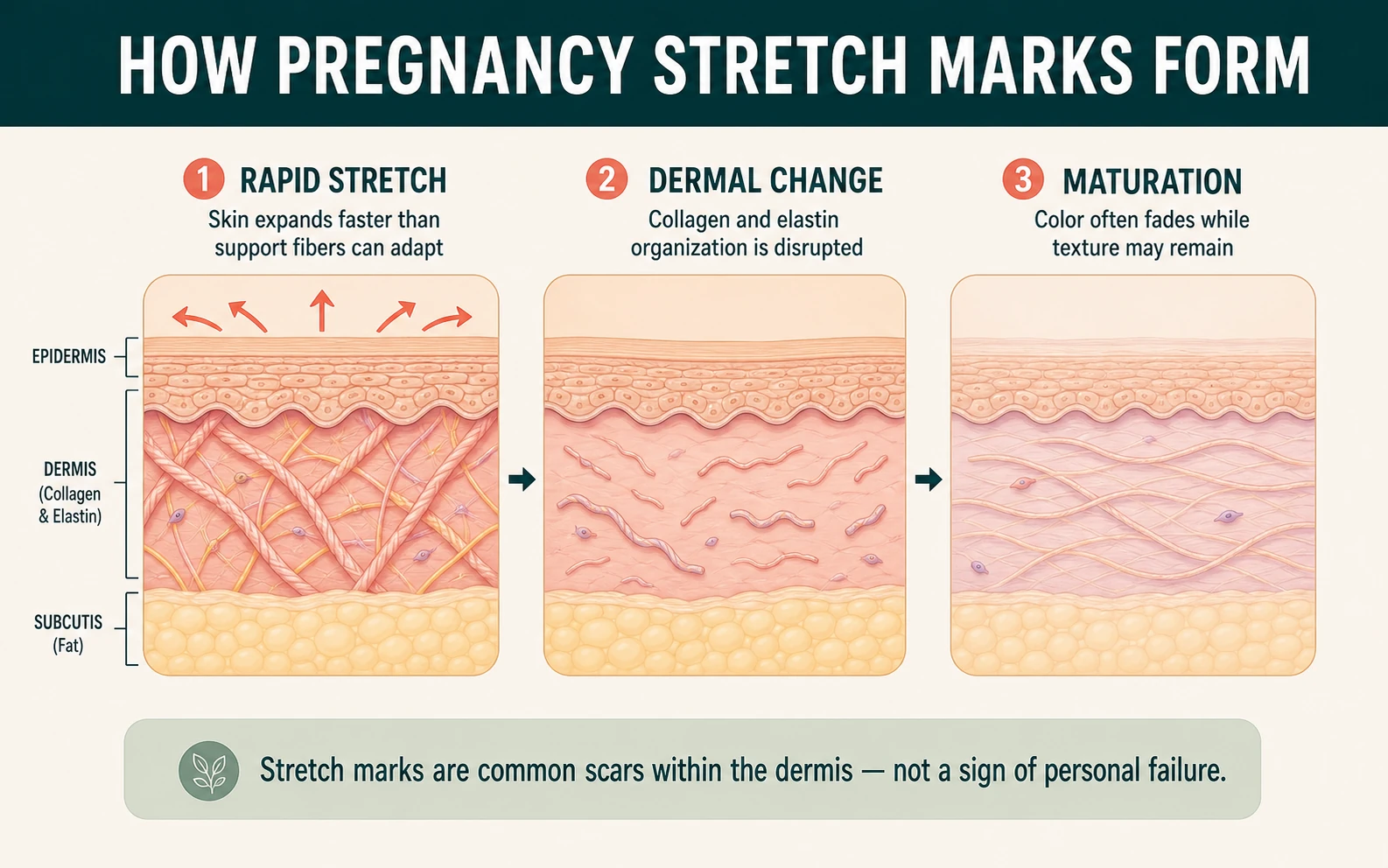
Stretch marks (medically called striae distensae, or striae gravidarum when pregnancy-related) are not surface-level marks. They are ruptures in the dermis — the middle layer of skin — where collagen and elastin fibers break under mechanical stress from rapid stretching.1
During pregnancy, the abdomen expands significantly over a relatively short period. The skin’s collagen network, which provides structural support, can be stretched beyond its capacity. When collagen fibers snap, the skin’s internal scaffolding is damaged, and what you see on the surface is the resulting scar tissue showing through the thinned outer layer.
Hormonal changes during pregnancy also play a role. Elevated cortisol reduces the skin’s ability to produce new collagen, and estrogen changes affect connective tissue flexibility. This combination of mechanical stress and hormonal vulnerability is why pregnancy is one of the most common triggers for stretch marks.1
Common locations include the lower abdomen, hips, breasts, and thighs — the areas where stretching is most pronounced during pregnancy.
Who Is More Likely to Get Them
Research identifies several risk factors for developing stretch marks during pregnancy:
Risk Factors for Pregnancy Stretch Marks
- Family history: The strongest predictor — if your mother had significant stretch marks, you are much more likely to develop them
- Rate of weight gain: Rapid weight gain stretches the skin faster than it can adapt
- Total stretching: Larger babies, multiple pregnancies, and carrying multiples increase the degree of stretch
- Age: Younger women are actually more prone (possibly due to tighter skin with less give)
- Skin tone: Stretch marks occur across all skin tones but are often more visible on lighter skin in early stages and on darker skin as they mature
- Previous stretch marks: A history of stretch marks from puberty or prior pregnancy increases likelihood
Notably absent from this list: skin care routine. There is no evidence that any moisturizer, oil, or topical product used during pregnancy prevents stretch marks. We will address this more directly below, because misinformation about prevention is pervasive.2
Striae Rubra vs Alba
Stretch marks after pregnancy go through predictable stages, and understanding this timeline helps set realistic expectations. Dermatologists divide them into two main phases: striae rubrae (the early, red or purple stage) and striae albae (the mature, pale or silvery stage). Which phase you are in determines both how the marks look and how they will respond to any treatment you might consider.3
Early Stage: Striae Rubrae (Red/Purple)
New stretch marks are called striae rubrae. They appear as raised, red, pink, purple, or dark lines depending on skin tone. They may itch or feel slightly irritated. The color comes from blood vessels showing through the damaged dermis and the inflammatory response to the tissue injury.
This stage typically lasts several months postpartum. The marks may be quite vivid and distressing, but this is their most responsive stage for treatment if treatment is desired.
Transitional Stage
Over the following months, the marks begin to flatten and lose their vivid color. Red becomes pink, purple becomes brownish. The itching subsides. The texture begins to change from raised to level with or slightly depressed below the surrounding skin.
Mature Stage: Striae Albae (Pale/Silvery)
Mature stretch marks, called striae albae, are their final form. They appear as pale, white, or silvery lines that are slightly indented and have a different texture from surrounding skin (smoother, without normal skin lines). On darker skin tones, they may appear lighter than the surrounding skin.
This maturation process takes 12–24 months. The marks become significantly less noticeable over time, but they do not disappear. The structural damage to the dermis is permanent.
What the Evidence Says About Creams and Oils
This is where we need to be honest about stretch marks after pregnancy, even though the truth is not what the beauty industry sells:
No topical product has been proven to prevent or eliminate stretch marks.
A 2012 Cochrane systematic review examined all available evidence on topical preparations for preventing stretch marks during pregnancy. The conclusion: there was no high-quality evidence that any preparation (cocoa butter, olive oil, vitamin E oil, or any commercial product) prevented stretch marks.2
What topicals can do:
- Moisturize: Keeping skin hydrated improves comfort and may reduce itching, but does not prevent the underlying dermal rupture
- Retinoids (tretinoin): There is moderate evidence that topical retinoids can improve the appearance of early (red) stretch marks by stimulating collagen production. However, retinoids are not safe during pregnancy or breastfeeding and should only be used postpartum after breastfeeding has ended, under medical guidance.3
- Hyaluronic acid: Limited evidence suggests some improvement in early stretch marks
If a product claims to “remove stretch marks,” it is making a claim not supported by evidence. This is not a judgment on people who use these products — if moisturizing makes your skin feel better, there is no harm. But spending significant money on products marketed to eliminate stretch marks is unlikely to produce the advertised results.
In-Office Options
In-office procedures have the most evidence of any intervention for improving stretch marks after pregnancy, though expectations should remain realistic:
Fractional laser therapy (ablative and non-ablative) creates microscopic wounds in the skin, stimulating collagen production and remodeling. Multiple studies show improvement in stretch mark texture, color, and overall appearance with a series of treatments.3
Pulsed dye laser (PDL) targets the blood vessels in early (red) stretch marks and is most effective during the striae rubrae stage. It can reduce the redness and improve texture.
Microneedling (also called collagen induction therapy) uses tiny needles to create controlled micro-injuries, stimulating collagen production. Some studies show comparable results to fractional laser for stretch mark improvement.4
What to expect realistically: These treatments can improve stretch mark appearance by perhaps 20–60% depending on the study and measurement method. They do not eliminate stretch marks or return skin to its pre-stretch-mark state. Multiple sessions are typically needed (3–6+), and results vary significantly between individuals.
These treatments are most effective on early (red/purple) stretch marks and have less impact on mature (white/silvery) ones. Timing matters.
What Surgery Removes and What It Doesn’t
Abdominoplasty (tummy tuck) is the only procedure that physically removes stretch marks — but only the marks on the skin that is excised during surgery. Understanding this distinction is essential.
A standard abdominoplasty removes the skin between the belly button and the pubic area. This is where many pregnancy stretch marks are concentrated, so the procedure can eliminate a significant portion of lower abdominal stretch marks.5
What is NOT removed:
- Stretch marks above the belly button (this skin is pulled down but not excised)
- Stretch marks on the flanks (sides)
- Stretch marks on the hips, thighs, or breasts
If your primary concern is stretch marks rather than skin laxity or muscle separation, abdominoplasty may not be the right procedure. It is designed to address excess skin and muscle separation — stretch mark removal is a secondary benefit in the excision zone, not the primary purpose.
Stretch marks that remain — and other skin-quality changes surgery cannot fix — belong in the broader picture of what surgery doesn’t change, our realistic-expectations guide.
Normalizing: Most People Have Them
Stretch marks after pregnancy can be a significant source of self-consciousness for some women, and that experience is valid. At the same time, they are extraordinarily common — estimated to affect 50–90% of pregnant women — and they are a normal physiological response to a remarkable process.
Some women feel neutral about their stretch marks. Some feel proud of them. Some are bothered by them. All of these responses are legitimate, and none requires justification.
What is not helpful is the idea that stretch marks need to be “fixed.” If you want to explore treatments, you should have accurate information about what is and is not possible. If you are comfortable with your marks as they are, you do not need anyone telling you to treat them. And if how you feel about your body is significantly affecting your quality of life, speaking with a mental health professional is a reasonable and valuable step.
Frequently Asked Questions
Do stretch marks from pregnancy go away?
Stretch marks fade significantly over 12–24 months — red or purple marks become lighter, flatter, and less noticeable. However, they do not disappear completely. Mature stretch marks (striae albae) are permanent changes to the skin’s structure. Their final appearance depends on skin tone, genetics, and severity.
Can any cream prevent stretch marks during pregnancy?
No cream has been proven to prevent stretch marks. Despite widespread marketing claims, systematic reviews show that cocoa butter, vitamin E, olive oil, and other topical products do not prevent stretch mark formation. Genetics and the degree of skin stretching are the primary determinants. Keeping skin hydrated may improve comfort but does not prevent the underlying collagen rupture.
What treatments work best for stretch marks?
No treatment eliminates stretch marks completely. Treatments that show moderate evidence for improvement include fractional laser therapy (most studied), microneedling, and topical retinoids (not safe during pregnancy or breastfeeding). These treatments can improve texture, color, and overall appearance but cannot restore skin to its pre-stretch-mark state.
Does surgery remove stretch marks?
Surgery (such as abdominoplasty) physically removes the skin containing stretch marks — but only the skin that is excised. Stretch marks on the remaining skin stay. An abdominoplasty typically removes lower abdominal skin between the belly button and the pubic area, which is where many pregnancy stretch marks are concentrated, but marks above the belly button or on the flanks remain.
Why did I get stretch marks and my friend didn’t?
Genetics are the strongest predictor of stretch mark development. If your mother had significant stretch marks, you are more likely to develop them. Other factors include how rapidly weight is gained, the total amount of skin stretching, skin tone, age (younger skin is actually more prone), and hormonal factors. It is not related to how well you cared for your skin.
Key Takeaways
- Stretch marks are structural damage to the dermis (collagen/elastin rupture), not a surface issue
- They fade dramatically over 12–24 months from red/purple to pale/silvery, but do not disappear
- Genetics are the strongest predictor — no cream or prevention product has been proven effective
- Laser therapy and microneedling can moderately improve appearance, especially while marks are still red
- Surgery removes only the stretch marks on excised skin; marks elsewhere remain
- Stretch marks affect 50–90% of pregnant women and are a normal physiological response
Sources
- Ud-Din S, McGeorge D, Bayat A. Topical management of striae distensae (stretch marks): prevention and therapy of striae rubrae and albae. J Eur Acad Dermatol Venereol. 2016;30(2):211-22.
- Brennan M, Young G, Devane D. Topical preparations for preventing stretch marks in pregnancy. Cochrane Database Syst Rev. 2012;11(11):CD000066.
- Al-Himdani S, Ud-Din S, Gilmore S, et al. Striae distensae: a comprehensive review and evidence-based evaluation of prophylaxis and treatment. Br J Dermatol. 2014;170(3):527-47.
- Defined per ASPS guidelines. Laser Skin Resurfacing. American Society of Plastic Surgeons. 2024.
- ASPS. Tummy Tuck (Abdominoplasty). American Society of Plastic Surgeons. 2024.