
C-Section Scar Massage: When to Start, How to Do It & What It Can Achieve
Key Takeaway
C-section scar massage is a simple, evidence-supported technique that helps prevent scar adhesions, improve tissue mobility, and reduce the tethered look of a healing cesarean scar. Most providers recommend starting around 6 weeks postpartum. It won’t erase a scar, but consistent mobilization can make a meaningful difference in how the tissue feels and moves.
What Scar Massage Actually Does
When your c-section incision heals, the body lays down collagen fibers to repair the wound. These fibers do not organize neatly — they form in a dense, somewhat random pattern that can bind the scar to the underlying layers of tissue, including muscle fascia. These connections are called adhesions.
Scar massage (also called scar mobilization or scar tissue release) physically disrupts these adhesions by moving the scar tissue in multiple directions. The goal is to restore the natural gliding motion between skin, subcutaneous fat, and the fascial layer so the scar does not feel “stuck down.”1
When adhesions are left in place, they can contribute to:
- The visible “shelf” or tethering above the scar line
- A pulling sensation during movement or stretching
- Discomfort or tightness during core exercises
- Altered movement patterns that can affect posture and pelvic floor function
What the Evidence Says
Research specifically on cesarean-scar massage is limited. A 2019 systematic review included nine studies of soft-tissue mobilization for surgical and non-surgical abdominal adhesions; it reported improvements in pain and function and some improvements in scar mobility, but it did not establish a c-section-specific schedule or prove a better cosmetic result.2
Laboratory research shows that mechanical stretch can alter signaling and collagen-related activity in connective tissue. However, the cited study used mouse tissue and does not establish a C-section massage schedule or prove a better-looking clinical scar.3 Begin scar massage only after the wound is fully closed and your clinician has cleared it.
It is important to be honest about what scar massage can and cannot do. The evidence supports improvements in pliability, reduced adhesion, and modest cosmetic improvement. There is less evidence that it dramatically changes scar color or width. Scar massage is a helpful, low-risk intervention — not a miracle cure.
When to Start
The general guideline is approximately 6 weeks postpartum, but the real criterion is wound readiness, not a calendar date. Before beginning scar massage, your incision should be:
- Fully closed with no scabs, crusting, or open areas
- Free of signs of infection (no redness spreading from the scar, no discharge, no warmth)
- Cleared by your OB, midwife, or healthcare provider
If your incision is still healing at 6 weeks (which can happen, especially with infections or wound complications), wait until it is ready. Starting too early risks reopening the wound or introducing bacteria.
There is no upper time limit. Women who are months or even years post-cesarean can still benefit from scar mobilization, especially if they notice adhesion-related symptoms like pulling or tightness.
How to Do It — Step by Step
You can perform these techniques at home. Use clean, dry hands. A small amount of unscented oil or moisturizer can reduce friction but is not required. Start gently and increase pressure gradually over weeks as the tissue becomes more mobile.
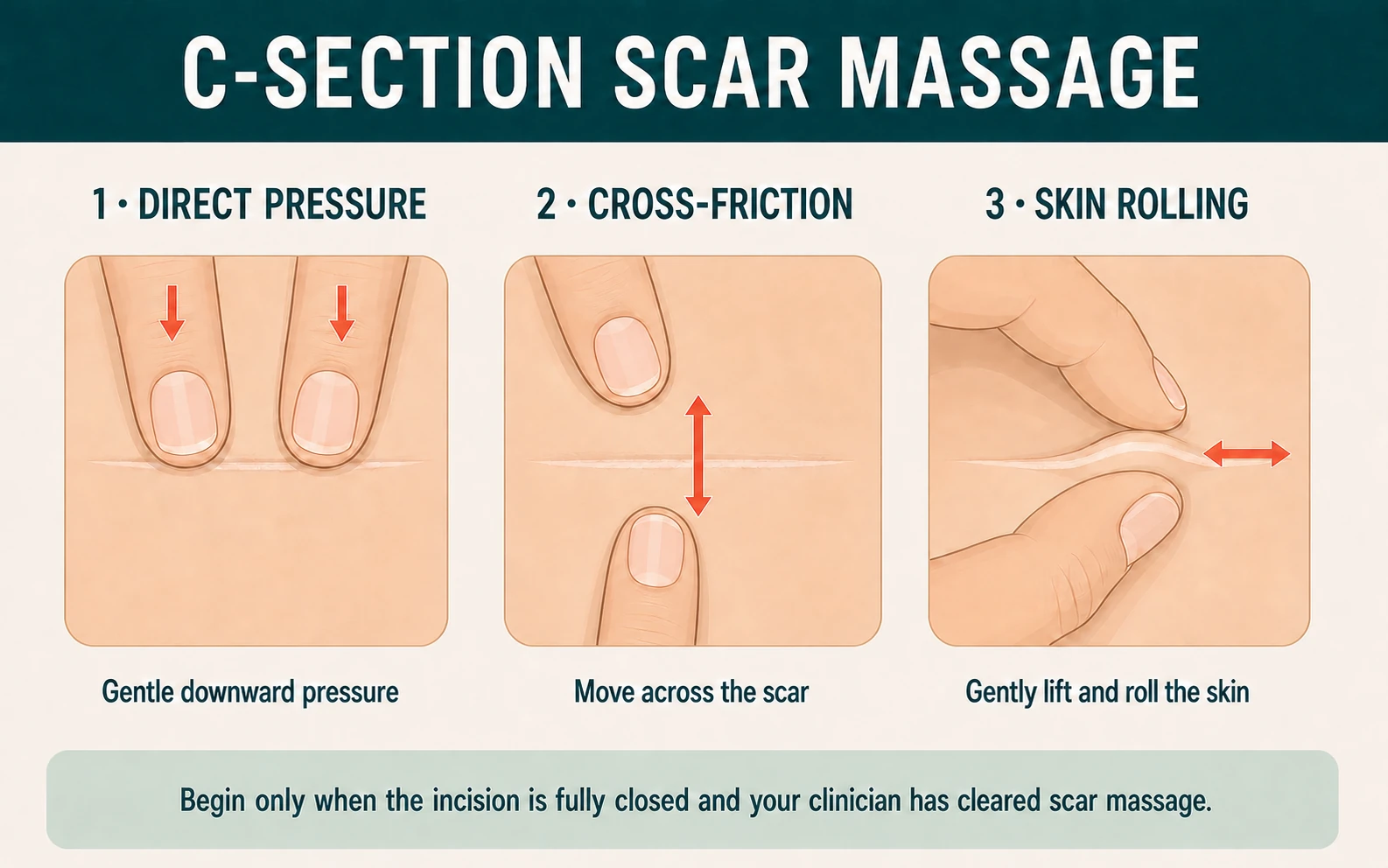
1. Direct Pressure (Desensitization)
Place your fingertips directly on the scar and press gently into the tissue. Hold for 10–15 seconds. This is especially helpful if the scar area is sensitive or hypersensitive to touch — it helps retrain the nerve endings.
Move along the length of the scar, applying gentle sustained pressure at intervals. You should feel pressure but not pain.
2. Circular Massage
Place two or three fingertips on the scar and make small circular motions, moving the skin and tissue beneath it rather than sliding over the surface. Work along the entire length of the scar.
Try this in both directions (clockwise and counterclockwise). You are aiming to feel the tissue moving under your fingers. If the tissue feels “stuck” and does not move, that area has more adhesion — spend a bit more time there, but do not force it.
3. Cross-Friction (Perpendicular)
Place your fingertips on the scar and move the tissue up and down (perpendicular to the scar line). This cross-friction technique is one of the most effective for breaking adhesions between the scar and the fascia below.
You should be moving the skin and underlying tissue together, not sliding your fingers across the skin surface. Think of it as moving the scar itself, not rubbing the skin.
4. Skin Rolling
Once the scar has gained some mobility (typically a few weeks into your massage routine), try gently pinching the scar between your thumb and forefinger and rolling the tissue. Lift the scar away from the underlying layers.
If the scar does not lift at all, the adhesions are tight. Continue with the other techniques and try skin rolling again in a week or two. Over time, you should feel the tissue becoming more pliable and easier to lift.
5. Longitudinal Stretching
Place one finger at each end of the scar and gently stretch the tissue lengthwise, then release. You can also anchor one end and stretch the other. This helps the scar become more elastic and less rigid.
How Often and How Long
Recommended Routine
- Frequency: Once or twice daily
- Duration per session: 5–10 minutes
- Total duration: At least 3–6 months for best results
- Pressure: Firm enough to move tissue, not enough to cause pain
- Best time: After a warm shower when tissue is relaxed
Consistency is significantly more important than intensity. Five minutes every day produces better results than 30 minutes once a week. Many women incorporate scar massage into their evening routine or perform it while the baby naps.
What You Should and Shouldn’t Feel
Normal sensations during massage:
- Pulling or stretching
- Mild tenderness or sensitivity
- A sensation of “release” as adhesions loosen
- Tingling (nerve-related, common in the first few weeks)
Stop and reassess if you feel:
- Sharp or stabbing pain
- Burning sensation
- Increased redness or swelling that persists after massage
- Any opening of the scar or bleeding
Some discomfort is expected, especially early on when adhesions are tight. But pain is a signal — reduce your pressure or wait a few more days before trying again.
Combining Massage with Silicone
Scar massage and silicone sheeting work through different mechanisms and can be used together effectively. A practical approach:
- Remove your silicone sheet
- Perform your scar massage routine (5–10 minutes)
- Clean the scar area and reapply the silicone sheet
Silicone hydrates the scar surface and regulates collagen production, while massage addresses the deeper adhesions and tissue mobility. Using both provides coverage of different aspects of scar healing. For more on silicone evidence, see our c-section scar healing timeline.
When to See a Physical Therapist
Many women perform effective scar massage at home. However, a referral to a pelvic floor or women’s health physical therapist may be helpful if:
Scar tissue is one of the specific causes of chronic pelvic pain that APTA’s consumer guide on pelvic pain identifies as responsive to targeted physical therapy — particularly when combined with the muscle identification, movement instruction, and graded exposure that a pelvic health specialist provides.5
- Your scar feels very firmly adhered and does not respond to home massage after several weeks
- You experience pain at or around the scar that interferes with daily activities
- You have symptoms that suggest deeper adhesions (pulling with certain movements, pain during exercise, bladder or bowel symptoms)
- You also have pelvic floor dysfunction or diastasis recti that should be addressed alongside scar work
- You want hands-on instruction to make sure your technique is effective
Evidence for C-section scar mobilization remains limited. A small proof-of-concept clinical study found that two weekly standardized soft-tissue mobilization sessions may improve some scar properties and pain measures.4 A pelvic health physical therapist can determine whether graded hands-on work and guided movement are appropriate after the wound is fully healed. For the broader timeline on exercise after c-section, see our progression guide.
If Massage Doesn’t Help
For some women, scar massage provides clear improvement; for others, the benefits are more modest. If you have been consistent with massage for 3–6 months and still experience significant adhesion, tethering, or discomfort, consider:
- Professional scar therapy: A physical therapist may use techniques you cannot replicate at home
- Corticosteroid injections: For hypertrophic or keloid scars that remain raised and firm
- Time: Scar remodeling continues for 12–18 months; massage at month 3 may show more results by month 9
- Surgical revision: In rare cases, adhesions are severe enough to warrant surgical release; this is typically a conversation with a board-certified plastic surgeon after conservative measures have been given adequate time
If your concern is primarily the visible c-section pooch or overhang, understand that the shelf involves multiple factors beyond adhesion alone, including skin laxity and fat distribution. Scar massage addresses only the adhesion component.
Frequently Asked Questions
When can I start massaging my c-section scar?
Most healthcare providers recommend waiting until approximately 6 weeks postpartum, once the incision is fully closed with no scabs, open areas, or signs of infection. Always get clearance from your OB or midwife before beginning scar massage.
How often should I massage my c-section scar?
Aim for 5–10 minutes of scar massage once or twice daily. Consistency matters more than duration — a brief daily session is more effective than occasional longer sessions.
Should scar massage hurt?
Scar massage should not be painful. You may feel pulling, stretching, or mild discomfort as you mobilize the tissue, and the area may feel tender or sensitive. Sharp pain, burning, or increased redness after massage means you are pressing too hard or the tissue is not yet ready.
Can scar massage get rid of my c-section shelf?
Scar massage can help reduce the tethered appearance of a c-section shelf by releasing adhesions between the scar and underlying fascia. However, if the shelf is primarily caused by skin laxity or fat distribution, massage alone is unlikely to eliminate it. It is one helpful tool among several, not a complete solution.
Do I need a physical therapist for scar massage?
Not necessarily. Many women perform effective scar massage at home after learning the basic techniques. However, a pelvic floor or women’s health physical therapist can be especially helpful if your scar feels very stuck or painful, if you have significant adhesions, or if you are also dealing with core or pelvic floor issues.
Key Takeaways
- Scar massage helps break adhesions between your c-section scar and the underlying tissue layers
- Start around 6 weeks postpartum once the incision is fully closed and cleared by your provider
- Key techniques: direct pressure, circular massage, cross-friction, skin rolling, and longitudinal stretching
- 5–10 minutes daily for at least 3–6 months produces the best results
- Massage should feel like pulling or stretching — not sharp pain
- Combining massage with silicone sheeting addresses different aspects of scar healing
- A women’s health physical therapist can help with stubborn adhesions or technique guidance
Sources
- Bordoni B, Zanier E. Skin, fascias, and scars: symptoms and systemic connections. J Multidiscip Healthc. 2013;7:11-24.
- Wasserman JB, Copeland M, Upp M, et al. Effect of soft tissue mobilization techniques on adhesion-related pain and function in the abdomen: A systematic review. J Bodyw Mov Ther. 2019;23(2):262-269.
- Bouffard NA, Cutroneo KR, Badger GJ, et al. Tissue stretch decreases soluble TGF-beta1 and type-1 procollagen in mouse subcutaneous connective tissue: evidence from ex vivo and in vivo models. J Cell Physiol. 2008;214(2):389-95.
- Gilbert I, Gaudreault N, Gaboury I. Exploring the Effects of Standardized Soft Tissue Mobilization on the Viscoelastic Properties, Pressure Pain Thresholds, and Tactile Pressure Thresholds of the Cesarean Section Scar. J Integr Complement Med. 2022;28(4):355-362.
- American Physical Therapy Association. Physical Therapy Guide to Pelvic Pain. ChoosePT. Last revised 2021.